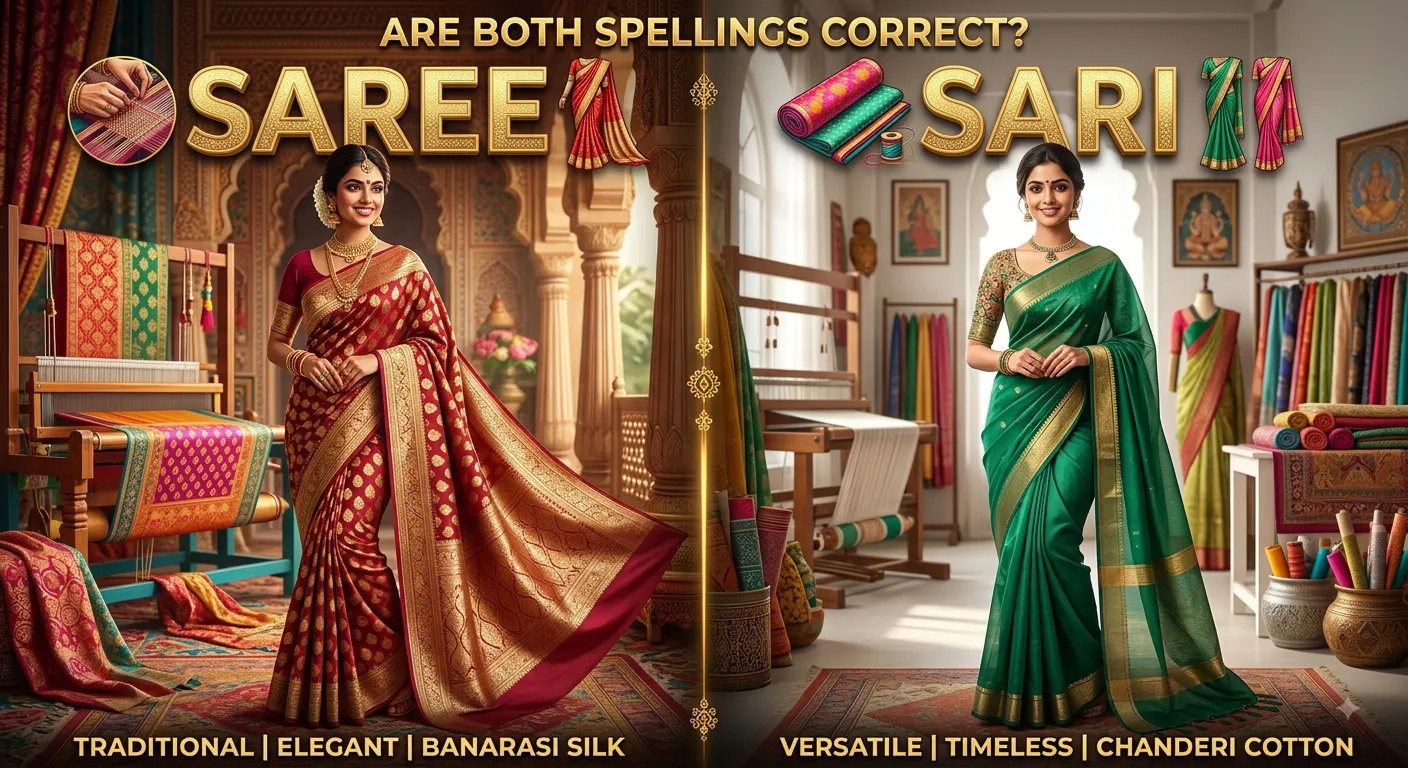
Saree and sari are both correct spellings for the same traditional South Asian garment, with sari being the main dictionary form and saree an accepted variant.
Quick Answer
Yes, saree and sari are both correct spellings for the same traditional South Asian garment. Sari is the main spelling used in major English dictionaries, while saree is a recognized variant, especially common in South Asian usage.
Quick Comparison
| Spelling | Correct? | Meaning | Usage |
|---|---|---|---|
| Sari | Yes | A traditional South Asian garment made from a long piece of cloth | Main dictionary form; widely used |
| Saree | Yes | The same traditional garment | Recognized variant; common in South Asian usage |
Why Are “Saree” and “Sari” Both Used?
If you have seen both sari and saree, you may have wondered whether one is a spelling mistake. The answer is no. Both forms are used in English to name the same traditional garment.
The difference comes from how a word from a South Asian language is represented in the Roman alphabet. English does not have one fixed system for spelling every borrowed word from another language, so more than one English spelling can develop.
Today, sari is the main dictionary form. Merriam-Webster lists saree as a variant, while Collins also recognizes saree alongside sari.
So, if you write:
She wore a beautiful sari.
or:
She wore a beautiful saree.
Both sentences are correct.
What Does “Sari” Mean?
Sari a long piece of cloth traditionally wrapped around the body as a garment in South Asia.
A sari is commonly made from materials such as cotton, silk, or synthetic fabrics. It can be worn in different styles depending on regional and cultural traditions.
Examples
- She wore a red silk sari.
- Her grandmother gave her a beautiful sari.
- The designer created a modern sari collection.
The word can be used in both everyday and formal writing.
What Does “Saree” Mean?
Saree a variant spelling of sari, referring to the same traditional South Asian garment.
For example:
She bought a traditional silk saree.
There is no difference in the garment itself. The difference is simply the spelling.
Merriam-Webster describes saree as a less common variant of sari, while Collins gives saree as an alternative spelling.
“Saree” vs. “Sari”: What’s the Difference?
The most important point is that saree and sari do not refer to two different garments.
| Feature | Sari | Saree |
|---|---|---|
| Correct spelling | Yes | Yes |
| Meaning | Traditional South Asian garment | Same garment |
| Pronunciation | Generally the same | Generally the same |
| Dictionary status | Main form in major dictionaries | Recognized variant |
| Meaning difference | None | None |
| British/American difference | Not strictly regional | Not strictly regional |
Unlike color/colour or organize/organise, this is not a simple American-vs-British spelling difference. Both forms can be found in British and American English. Collins, for example, lists sari and saree in both its British and American entries.
Is “Saree” British English and “Sari” American English?
No. It would be misleading to say that saree is British English and sari is American English.
Both spellings are used in different varieties of English.
However, sari is generally the safer choice if you want the main dictionary form for general English writing. Saree is also perfectly acceptable, particularly when it matches the spelling commonly used by your audience, publication, business, or cultural context.
A simple guide
- General English: sari is a strong default.
- South Asian fashion or cultural writing: sari and saree can both be appropriate.
- Product descriptions: Follow the spelling used by the brand or market.
- Formal writing: sari is a safe choice because it is the main dictionary form.
The key is consistency. If you choose one spelling for an article, use it consistently unless you are discussing the variant itself.
What Major Dictionaries Say About “Sari” and “Saree”
Major English dictionaries agree that sari and saree refer to the same traditional South Asian garment. They generally treat sari as the main entry, while recognizing saree as an alternative or variant spelling.
| Dictionary | Main Form | Treatment of “Saree” | Key Point |
|---|---|---|---|
| Merriam-Webster | sari | Variant | Lists “saree” as a variant of sari. |
| Cambridge Dictionary | sari | Also saree | Gives saree as an alternative spelling. |
| Collins Dictionary | sari | saree | Recognizes both forms in British and American English entries. |
| Dictionary.com | sari | Or saree | Lists saree as an alternative spelling. |
What Does This Tell Us?
The dictionary evidence is clear: saree is not simply a misspelling of sari. It is an accepted variant spelling.
However, sari is generally the better default if you want to use the main dictionary form in general English writing. If your audience, publication, or cultural context commonly uses saree, that spelling is also perfectly acceptable.
The key point is that this is not a strict British-versus-American spelling difference. Both forms are recognized in English, so your choice can depend on audience, context, and consistency.
Which Spelling Should You Use?
If you are unsure, sari is the simplest choice.
Major dictionaries treat sari as the main entry and saree as a variant.
For example:
The museum displayed a traditional sari.
This is completely standard.
But you can also write:
The museum displayed a traditional saree.
This is also correct.
Remember
Sari = standard/main dictionary form
Saree = accepted variant
Neither spelling changes the basic meaning.
Pronunciation
Both sari and saree are generally pronounced in the same way.
A common English pronunciation is approximately:
Sari: /ˈsɑːri/
Saree: /ˈsɑːri/
The exact pronunciation may vary slightly across speakers and English varieties.
The extra e in saree does not create a different garment or a major difference in meaning.
Origin of “Sari” and “Saree”
The English word sari comes from Hindi and Urdu sāṛī, ultimately from Sanskrit śāṭī, meaning “strip of cloth.” Merriam-Webster dates the first known English use of sari to 1785.
The spelling saree developed as an alternative English representation of the same word. English has borrowed many words from South Asian languages, and different spellings can arise when words are represented in the Roman alphabet.
This is why sari and saree can coexist without having different meanings.
Grammar Rule
Sari and saree are countable nouns.
Singular
She wore a beautiful sari.
She bought a silk saree.
Plural
The plural of sari is commonly saris.
The shop sells colorful saris.
For saree, sarees is commonly used.
The store displayed several traditional sarees.
Collins specifically lists saris as the plural of sari and recognizes -ris or -rees for the British entry.
Common Mistakes
| Common Mistake | Correct Form | Why? |
|---|---|---|
| Thinking saree is always wrong | saree is correct | It is a recognized variant. |
| Thinking sari is only American | sari is widely used | It is not restricted to American English. |
| Thinking they describe different clothes | They describe the same garment | The difference is spelling. |
| Using saris for every spelling | saris / sarees | Plural forms can follow the spelling used. |
| Switching randomly between forms | Choose one and stay consistent | Consistency makes writing clearer. |
Real-World Examples
Everyday Writing
My sister bought a new sari for the wedding.
South Asian Cultural Context
The exhibition featured traditional sarees from different regions.
Fashion Writing
The designer presented a collection of silk saris.
Academic Writing
The sari has a long history in South Asian dress traditions.
Shopping Context
This store sells handmade sarees.
All of these uses can be correct. The choice often depends on the audience and context.
Easy Memory Trick
Think of the two forms as two spellings for one garment:
SARI = main dictionary spelling
SAREE = accepted variant
If you need a safe general-English choice, remember:
When in doubt, use “sari.”
But don’t treat saree as a spelling mistake. It is a recognized variant.
Vocabulary Corner
Here are some useful words related to sari/saree:
- garment: an item of clothing
- fabric: cloth used to make clothing
- silk: a smooth natural fabric
- drape: to arrange cloth loosely around something
- textile: cloth or material made by weaving or other methods
- traditional :connected with customs or practices passed down over time
Useful phrases include:
- silk sari
- traditional sari
- designer saree
- sari fabric
- sari draping
- traditional saree
What You’ll Learn
By the end of this guide, you will know:
- Sari and saree are both correct.
- They refer to the same traditional South Asian garment.
- Sari is the main dictionary form.
- Saree is a recognized variant.
- The difference is not strictly British vs. American English.
- You can choose either form based on audience and context.
Mini Quiz
Choose the best answer.
- Which spelling is the main dictionary form?
- a) sari
- b) saree
- Are sari and saree different garments?
- a) Yes
- b) No
- Is saree an incorrect spelling?
- a) Yes
- b) No
- Which is a safe choice for general English writing?
- a) sari
- b) saree
- c) Both, depending on context
Answers
- a) sari
- b) No
- b) No
- c) Both, depending on context
Standalone Comparison
| Term | Meaning | Status | Best Used When |
|---|---|---|---|
| Sari | Traditional South Asian garment | Main English form | General and formal English |
| Saree | Same garment | Accepted variant | South Asian, fashion, or regional contexts |
Frequently Asked Questions
Q: Are “sari” and “saree” both correct?
A: Yes. Sari is the main dictionary spelling, while saree is a recognized variant. Both refer to the same garment.
Q: Is “sari” British or American English?
A: Neither exclusively. Sari is used in both British and American English. Saree is also used in both varieties.
Q: Is “saree” a misspelling of “sari”?
A: No. Saree is a recognized variant spelling, although sari is generally the main dictionary form.
Q: Which spelling is more standard: “sari” or “saree”?
A: Sari is generally the more standard dictionary form. Major dictionaries such as Merriam-Webster list sari as the main entry and saree as a variant.
Q: Do “sari” and “saree” have different meanings?
A: No. They refer to the same traditional South Asian garment. The difference is spelling, not meaning.
Q: Which spelling should I use in formal writing?
A: Sari is a safe choice for formal and general English writing because it is the main dictionary form. However, saree is not incorrect.
Q: What is the plural of “sari”?
A: The common plural is saris. For saree, sarees is commonly used.
Key Takeaways
- Sari and saree are both correct spellings.
- Both words refer to the same traditional South Asian garment.
- Sari is generally the main dictionary form.
- Saree is a recognized variant.
- The difference is not simply British English vs. American English.
- When you want a safe general-English choice, sari is a good option.
Borrowed Words, Borrowed Choices
When English adopts a word from another language, it often ends up with more than one accepted spelling there’s rarely a single “official” way to transliterate a sound into the Latin alphabet. “Saree” and “sari” are a perfect example, both correct, both widely used, with the choice often coming down to regional or personal preference. The same thing happens with Sempai or Senpai another borrowed word with two accepted spellings, and closer to home with Imposter or Impostor where English simply settled on more than one “correct” answer.
Conclusion
So, are both saree and sari, correct? Yes. They are two accepted spellings for the same traditional South Asian garment. The main difference is that sari is generally treated as the standard or main dictionary form, while saree is a recognized variant.
It is also important not to label this as a simple British-versus-American spelling difference. Both forms are used in different English-speaking regions. If you are writing for a broad audience and want the safest general choice, sari is a good option. If your audience or context commonly uses saree, that spelling is perfectly acceptable too.
The easiest rule is: Sari is the main form; saree is an accepted variant. Choose the form that best suits your audience, and use it consistently.

Amna Akhtar is a writer dedicated to making English easier to understand. She creates research-informed guides on grammar, vocabulary, spelling differences, and commonly confused words, combining careful research with clear, practical explanations. She is also the co-author of the peer-reviewed research article “Determinants of Jobs Satisfaction of Female Teachers: An Evidence from District Hafizabad, Pakistan,” published in the Journal of Education and Social Studies (2021).