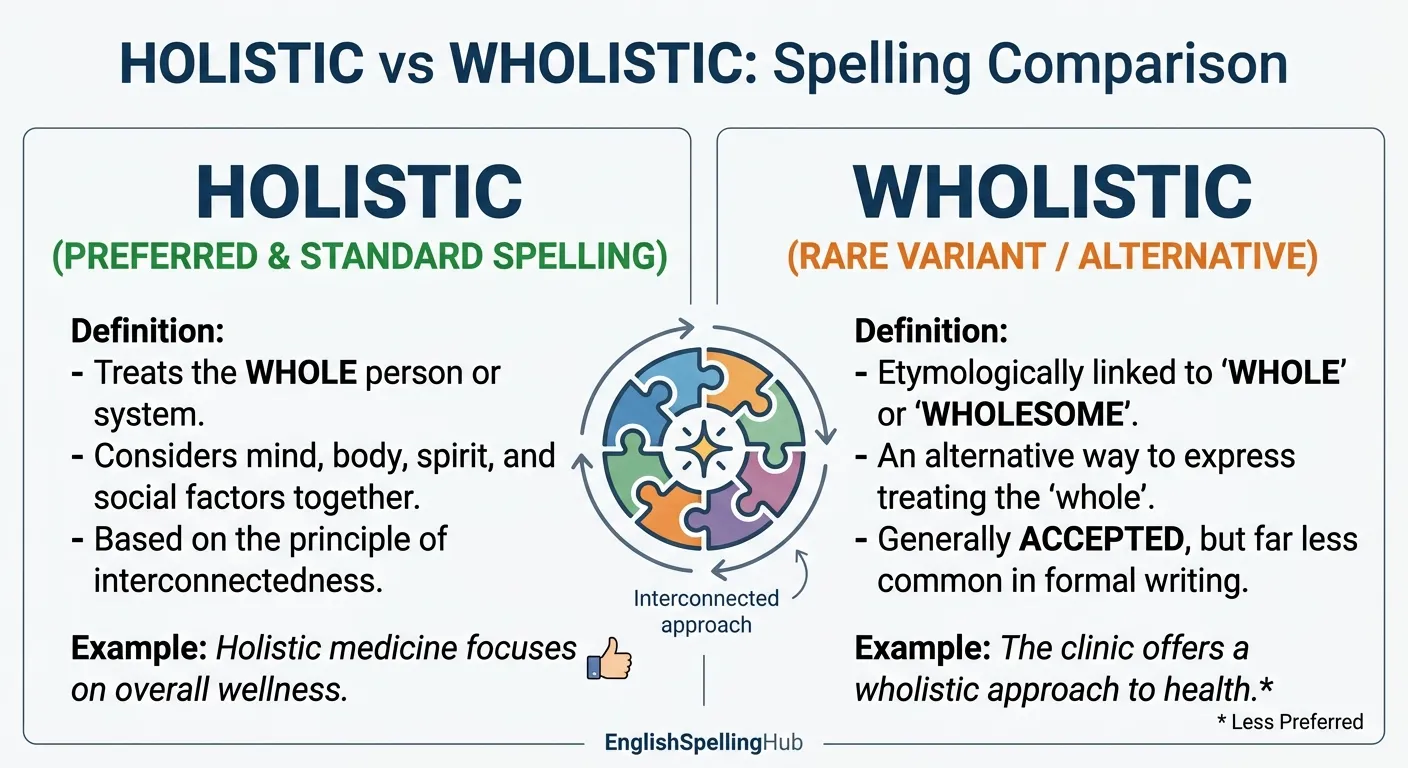
Holistic means considering a person, situation, or system as a complete whole rather than focusing only on individual parts while Wholistic is a less common variant of holistic with the same basic meaning.
Quick Answer
Holistic is the standard and widely accepted spelling. Wholistic is a real variant, but it is much less common and is often treated as a nonstandard or unnecessary spelling. In most formal, academic, and professional writing, holistic is the safer choice.
| Spelling | Correct? | Meaning | Usage |
|---|---|---|---|
| Holistic | Yes | Considering something as a whole | Standard and widely used |
| Wholistic | Variant | Considering something as a whole | Rare; less widely accepted |
What You’ll Learn
By the end of this guide, you will know:
- Whether holistic or wholistic is correct
- What each spelling means
- Why wholistic exists
- Which spelling to use in formal writing
- How to use holistic correctly in sentences
Introduction
Have you ever written wholistic because the word is connected to the idea of a “whole”? It seems logical. After all, whole is spelled with a w, so adding that letter to holistic may look like a natural choice.
However, English spelling does not always work that way.
The word most readers expect to see is holistic. It is the standard form used in education, healthcare, business, psychology, and many other fields. Wholistic can also be found in English, but it is much less common.
So, if you are wondering which spelling to use in an essay, report, website, or professional document, the answer is simple: choose holistic.
Holistic vs Wholistic: What’s the Difference?
Both holistic and wholistic are connected with the idea of considering something as a complete whole rather than looking at only one part.
Holistic
Holistic means considering all parts of something and how those parts work together.
For example:
A holistic approach to education considers a student’s academic, social, and emotional needs.
The word is commonly used with nouns such as:
- holistic approach
- holistic education
- holistic health
- holistic development
- holistic view
- holistic treatment
Wholistic
Wholistic has essentially the same intended meaning. It was formed to make the connection with whole more obvious.
For example:
The program takes a wholistic approach to student development.
The problem is not really the meaning. The main issue is standard usage and frequency.
Wholistic is far less common than holistic, and many style-conscious writers avoid it in favor of the established form.
Is Holistic or Wholistic the Correct Spelling?
Holistic is the preferred spelling.
If you are writing for school, university, work, publishing, or a professional website, use holistic.
For example:
- Correct/preferred: The school follows a holistic approach to learning.
- Less common: The school follows a wholistic approach to learning.
This does not mean that every appearance of wholistic is automatically a spelling error. It is a recognized variant found in some English usage. However, its use is uncommon compared with holistic.
The simple rule
Use holistic in most situations.
You normally do not need to change holistic to wholistic just because the word refers to a whole.
Why Is It Holistic Instead of Wholistic?
This is where the spelling becomes interesting.
Holistic comes from the word holism, which is based on the Greek word holos, meaning whole or entire.
The spelling therefore does not come directly from the English word whole.
That explains why holistic does not contain the w found in whole.
Wholistic, on the other hand, appears to have developed as a spelling that makes the word’s connection to whole more visually obvious.
So the two spellings have a logical connection to the same basic idea, but holistic is the established standard form.
According to Merriam-Webster, “wholistic” is not incorrect it emerged as a natural variant of “holistic” not long after the original word became standard, and it continues to appear in fields like finance and personal development where writers want to emphasize the idea of “wholeness.” Still, dictionaries confirm that “holistic” remains far more common, especially in academic and medical writing. You can read Merriam-Webster’s full breakdown of the word’s history here: Merriam-Webster: ‘Wholistic’: A Natural Evolution of ‘Holistic’.
Holistic: Meaning and Examples
Holistic considering a person, system, or situation as a complete whole rather than focusing on individual parts.
Here are some natural examples:
- The teacher uses a holistic approach to student development.
- We need a holistic view of the problem.
- The program supports holistic learning.
- Good leadership requires a holistic understanding of an organization.
- The doctor discussed a holistic approach to patient care.
Notice that holistic can describe both practical and abstract ideas.
Is Holistic Used in British and American English?
Yes. Holistic is used in both British English and American English.
This is not a typical British-versus-American spelling pair like:
- colour / color
- organise / organize
- travelled / traveled
There is no need to switch between holistic and wholistic based on whether you are writing for a British or American audience.
Holistic is widely understood and used across major varieties of English.
Grammar Rule
Grammar Rule: Holistic is an adjective. It describes an approach, view, method, treatment, or other noun that considers the whole rather than only separate parts.
Common patterns include:
holistic + noun
- holistic approach
- holistic education
- holistic development
- holistic treatment
- holistic perspective
You can also use it after a linking verb:
Her approach is holistic.
Word family
Related forms include:
- holism: the idea that a whole system is more than just its individual parts
- holistic: relating to a whole-system approach
- holistically: in a holistic manner
Common Mistakes
| Common Mistake | Preferred Form | Why? |
|---|---|---|
| wholistic approach | holistic approach | Holistic is the established standard form |
| holistical approach | holistic approach | Holistical is unnecessary |
| wholeistic approach | holistic approach | Wholeistic is not the standard spelling |
| holisitic | holistic | The letters are in the wrong order |
One especially common mistake is adding a w simply because the meaning relates to whole. Remember that the standard spelling comes through holism, not directly from the English spelling whole.
Real-World Usage
Education
The school takes a holistic approach to learning.
Here, the approach considers more than test scores. It may include academic, social, emotional, and personal development.
Healthcare
The clinic promotes a holistic approach to patient care.
The idea is to consider the person more broadly rather than focusing only on one symptom or condition.
Business
The company needs a holistic strategy for improving customer experience.
The strategy considers different parts of the customer journey together.
Personal Development
She takes a holistic approach to personal growth.
The focus may include several areas of life rather than just one goal.
Quick Grammar Check
Here is how holistic works in a sentence:
Correct: The university has a holistic admissions process.
Incorrect: The university has a holistically admissions process.
Why? Holistic is the adjective needed to describe the noun process. Holistically is an adverb and would be used differently.
For example:
The university evaluates applicants holistically.
Here, holistically describes how the university evaluates applicants.
Vocabulary Corner
Learning a few related words can make the meaning easier to remember.
| Word | Meaning |
|---|---|
| Holism | The idea of treating a whole system as more than its separate parts |
| Holistic | Considering the whole |
| Holistically | In a way that considers the whole |
| Whole | Complete or entire |
| Comprehensive | Covering many or all important parts |
A useful memory trick is:
Holistic → holism → Greek holos (“whole”)
You do not need the w in whole to spell holistic.
Mini Quiz
Choose the preferred spelling in each sentence.
- The teacher uses a ______ approach to education.
a) wholistic
b) holistic - We need a ______ understanding of the issue.
a) holistic
b) wholeistic - The program focuses on ______ development.
a) holistic
b) holistical
Answers
- b) holistic
- a) holistic
- a) holistic
Holistic vs Wholistic: Quick Comparison
| Term | Meaning | Usage | Best Choice? |
|---|---|---|---|
| Holistic | Considering the whole | Common and standard | Yes |
| Wholistic | Considering the whole | Rare variant | Usually avoid |
| Wholeistic | Intended to mean considering the whole | Nonstandard | No |
The key point is that holistic and wholistic are not normally different in meaning. The important difference is their standardness and frequency of use.
Frequently Asked Questions
Q: Is holistic the correct spelling?
A: Yes. Holistic is the standard and widely preferred spelling.
Q: Is wholistic a real word?
A: Yes. Wholistic is found in English as a variant spelling, but it is much less common than holistic.
Q: Is wholistic wrong?
A: It is better described as a rare variant rather than simply treating every occurrence as a spelling error. However, holistic is the safer and more widely accepted choice.
Q: Is holistic British or American English?
A: Holistic is used in both British and American English. It is not a British/American spelling difference.
Q: Why does holistic not have a W?
A: Holistic comes from holism, which is based on the Greek holos, meaning “whole.” It is not formed simply by adding a suffix to the English word whole.
Q: Should I use holistic in formal writing?
A: Yes. Holistic is the best choice for academic, professional, business, and formal writing.
Q: How do you use holistic in a sentence?
A: You can use it before a noun:
The school uses a holistic approach to education.
You can also use related forms such as holistically:
The student’s progress should be evaluated holistically.
A Familiar Kind of Preference
“Wholistic” isn’t a spelling mistake in the strict sense it exists, it’s been used since the 1940s, and some dictionaries even list it as a variant. But “holistic” has remained the dominant, standard choice, especially in academic and medical writing, leaving “wholistic” as the less-favored alternative. This same preferred-versus-secondary dynamic shows up in Boney or Bony and Savy or Savvy where usage not strict correctness decides which spelling actually belongs in professional writing.
Key Takeaways
- Holistic is the standard and preferred spelling.
- Wholistic is a much less common variant.
- Both forms relate to the idea of considering something as a whole.
- Holistic is used in both British and American English.
- Use holistic in academic, professional, and formal writing.
- The word is connected to holism and the Greek holos, meaning “whole.”
Conclusion
When choosing between holistic and wholistic, holistic is the clear winner for most writing. It is the established spelling used widely in education, healthcare, business, psychology, and many other fields.
Wholistic does exist as a variant, and its meaning is essentially the same. However, it is much less common, so using it can make your writing look unusual or raise doubts about the spelling.
The easiest rule to remember is simple: write holistic, not wholistic, unless you have a specific reason to use the rare variant.
Once you connect holistic with holism and holos (“whole”), the spelling becomes much easier to remember.

Rose Vault is an English language author who specializes in spelling comparisons, commonly confused words, and grammar. She creates clear, well-researched content that helps readers improve their writing and use English with confidence. Her goal is to make language learning simple, accurate, and accessible for everyone.