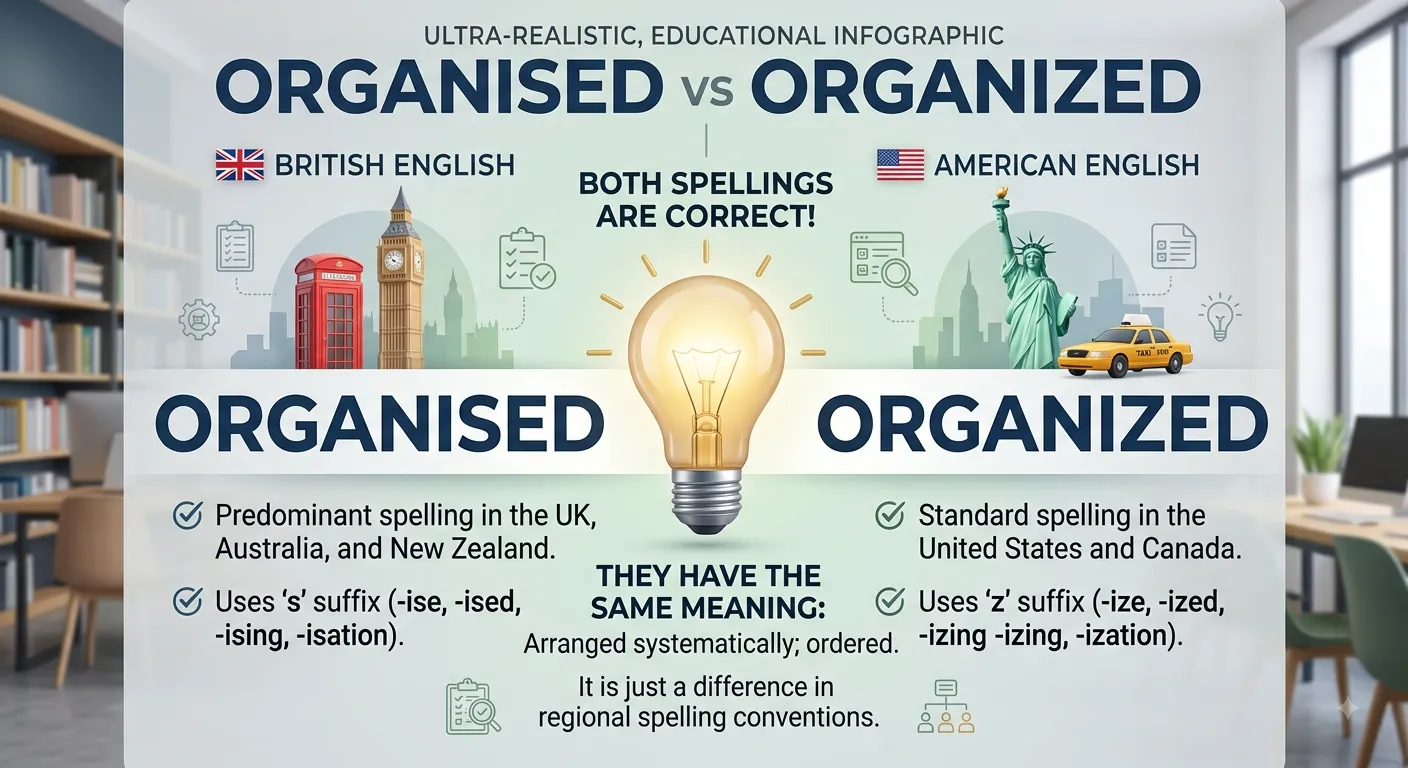
Organised: The British English spelling, meaning arranged, planned, or put into order.
Organized: The American English spelling, with the same meaning as organised.
Quick Answer
Organised is the standard British English spelling, while organized is the standard American English spelling. Both are correct; the difference is mainly regional.
| Spelling | English Variety | Correct? | Example |
|---|---|---|---|
| Organised | British English | Yes | She organised the meeting. |
| Organized | American English | Yes | She organized the meeting. |
What You’ll Learn
By the end of this guide, you will know:
- When to use organised and organized
- Which spelling belongs to British and American English
- Why the spellings are different
- How to use both forms correctly
- Which spelling to choose for your writing
Introduction
Have you ever written organised in one document and organized in another and wondered which one is actually correct? You are not alone. This is a common spelling difference for English learners because both forms look almost identical and have exactly the same meaning.
The difference is not about right versus wrong. It is mainly about English variety. British English usually prefers organised, while American English usually uses organized.
This spelling pattern is also seen in other words ending in -ise/-ize, such as realised/realized and recognised/recognized. However, there are some details worth knowing, especially if you write for an international audience.
The good news is simple: once you know which English variety you are following, choosing the correct spelling becomes easy.
Organised vs Organized: What’s the Difference?
Organised and organized are different spellings of the same word.
Both are forms of the verb organize/organise, which means to arrange or plan something in an orderly way.
Organised
Organised is the spelling commonly used in British English and many other varieties of English influenced by British usage.
The students organised a charity event.
Organized
Organized is the spelling commonly used in American English.
The students organized a charity event.
The meaning does not change. The difference is in the spelling convention.
Is Organised British or American?
Organised is primarily associated with British English.
It is commonly used in:
- The United Kingdom
- Many Commonwealth English contexts
- British-style educational writing
- Publications that follow British spelling conventions
For example:
The teacher organised a school trip.
If you are following British English spelling, organised is the natural choice.
Is Organized British or American?
Organized is the standard spelling in American English.
For example:
The teacher organized a school trip.
American English commonly uses -ize in words of this type.
You will therefore see:
- organize
- organized
- organizing
- organization
in American English.
Why Does British English Use -ise?
This is slightly more complicated than simply saying that British English always uses -ise.
British English commonly uses -ise in words such as:
- organise
- realise
- recognise
- apologise
However, -ize spellings are also accepted in some British English styles and dictionaries. The Oxford style traditionally favors -ize spellings in many such words, while -ise is very common in general British usage.
So it is more accurate to say:
-ise is very common in British English, while -ize is standard in American English.
If you are writing for a British audience, organised is a safe and familiar choice. If you are following a particular style guide, use that guide consistently.
Why Does American English Use -ize?
American English generally prefers -ize for this group of words.
This gives forms such as:
- organize
- organized
- recognize
- recognized
- realize
- realized
The spelling pattern is consistent across many words.
The important point is that organized is not an American misspelling of organised. It is the standard American form.
Are Organised and Organized Pronounced the Same?
Yes. In normal usage, organised and organized have the same pronunciation.
The spelling changes, but the pronunciation does not normally change because of the -s- versus -z- spelling.
A simple pronunciation guide is:
organised /ˈɔːɡənaɪzd/
organized /ˈɔːrɡənaɪzd/
The exact pronunciation can vary by accent, but the spelling difference itself does not create a different word or meaning.
Grammar Rule
Grammar Rule: Organised and organized are the past tense and past participle forms of organise/organize.
The choice depends on the spelling variety you are following.
British English
I organised the files yesterday.
American English
I organized the files yesterday.
The present forms also follow the same spelling pattern:
- British: organise
- American: organize
And the present participle is:
- organising in British English
- organizing in American English
Word forms at a glance
| Form | British English | American English |
|---|---|---|
| Base form | organise | organize |
| Past tense | organised | organized |
| -ing form | organising | organizing |
| Noun | organisation | organization |
Common Mistakes
| Common Mistake | Correct Form | Why? |
|---|---|---|
| Mixing organise and organized in one text | Choose one variety | Keep your spelling consistent |
| Writing organized as a British “error” | organized is valid | It is standard American English |
| Writing organised as an American spelling | organized | American English normally uses -ize |
| Using both forms randomly | Use one style consistently | Consistency makes writing clearer |
The biggest mistake is not choosing one form over the other. It is mixing spelling systems without a reason.
For example, if your article uses British English, you should normally write:
The team organised the event and recognised the winners.
Do not switch randomly to:
The team organized the event and recognised the winners.
Real-World Examples
British English
The school organised a sports day.
She organised all the documents carefully.
We organised a meeting for Monday.
American English
The school organized a sports day.
She organized all the documents carefully.
We organized a meeting for Monday.
The meaning remains exactly the same.
Academic Writing
British:
The researchers organised the data into three groups.
American:
The researchers organized the data into three groups.
Professional Writing
British:
The company organised a training session for new employees.
American:
The company organized a training session for new employees.
Grammar Relay Corner
Compare these sentences:
British English:
The manager organised the meeting.
American English:
The manager organized the meeting.
Both sentences are grammatically correct.
The only difference is the spelling convention.
The same pattern appears in the present tense:
British:
The manager organises weekly meetings.
American:
The manager organizes weekly meetings.
So remember the complete pattern rather than memorising only the past tense.
Vocabulary Corner
The word organise/organize has several useful related forms:
- organise/organize : arrange or plan something
- organised/organized : arranged or planned
- organising/organizing: arranging or planning
- organisation/organization: an organised group or the act of organising
- organiser/organizer : a person or thing that organises
British and American spelling differences continue through many of these forms.
For example:
British: organisation
American: organization
British: organiser
American: organizer
Which Spelling Should You Use?
The best spelling depends on your target audience.
Use organised when:
- You are writing in British English.
- Your school or institution follows British spelling.
- Your website uses British English consistently.
- Your audience mainly uses British English.
Use organized when:
- You are writing in American English.
- Your publication follows American spelling.
- Your target audience is mainly American.
- Your style guide requires -ize spellings.
What if your audience is international?
Choose one English variety and stay consistent.
For example, if your website generally uses British spelling, use organised throughout your content.
If it follows American English, use organized.
Consistency matters more than choosing one form as universally “better.”
Mini Quiz
Choose the correct spelling for the English variety given.
- British English:
The students ______ a debate.
a) organized
b) organised - American English:
The team ______ the event.
a) organised
b) organized - Which spelling is associated with British English?
a) organised
b) organized - Which spelling is standard in American English?
a) organised
b) organized
Answers
- b) organised
- b) organized
- a) organised
- b) organized
Organised vs Organized: Quick Comparison
| Term | Meaning | Region/Context | Best Used When |
|---|---|---|---|
| Organised | Arranged or planned | British English | Following British spelling |
| Organized | Arranged or planned | American English | Following American spelling |
There is no difference in meaning between the two forms. The key difference is the spelling convention.
Frequently Asked Questions
Q: Is organised or organized, correct?
A: Both are correct. Organised is commonly used in British English, while organized is standard in American English.
Q: Is organised British English?
A: Yes. Organised is the spelling commonly associated with British English and many other British-influenced varieties.
Q: Is organized American English?
A: Yes. Organized is the standard American English spelling.
Q: Do organised and organized have different meanings?
A: No. They have the same basic meaning: arranged, planned, or put into order.
Q: Can I use organized in British English?
A: Yes, -ize spellings can be found in British English, particularly in certain formal styles and dictionaries. However, organised is the more familiar choice in much general British usage.
Q: Which spelling should ESL learners use?
A: Use the spelling variety required by your school, teacher, workplace, or target audience. If you are learning British English, organised is a useful form to learn. For American English, use organized.
Q: Is organization also different in British and American English?
A: Yes. British English commonly uses organisation, while American English uses organization.
Key Takeaways
- Organised and organized are both correct spellings.
- Organised is commonly used in British English.
- Organized is standard in American English.
- The two forms have the same meaning and pronunciation.
- Other related words follow the same spelling pattern.
- Choose one English variety and use it consistently.
A Letter That Splits an Ocean
“Organised” and “organized” aren’t a right-or-wrong situation they’re a straight line down the middle of the Atlantic. British English favors the ‘s’, American English favors the ‘z’, and neither side is making a mistake. The same s/z divide shows up in Realised or Realized, while a related but slightly different British American pattern plays out in Cancelling or Canceling different letters, same underlying story of two English traditions going their own way.
Conclusion
The choice between organised and organized depends on the English variety you are using. Organised is the familiar British English spelling, while organized is the standard American English form.
Neither spelling is inherently more correct. The important thing is to match your spelling to your audience and remain consistent throughout your writing.
If you are writing in British English, use organised. If you are following American English, use organized. Once you learn this -ise/-ize pattern, you will also recognize it in words such as realised/realized and recognised/recognized.
Now you can choose the right form with confidence and, more importantly, keep your English spelling consistent.

Amna Akhtar is a writer dedicated to making English easier to understand. She creates research-informed guides on grammar, vocabulary, spelling differences, and commonly confused words, combining careful research with clear, practical explanations. She is also the co-author of the peer-reviewed research article “Determinants of Jobs Satisfaction of Female Teachers: An Evidence from District Hafizabad, Pakistan,” published in the Journal of Education and Social Studies (2021).