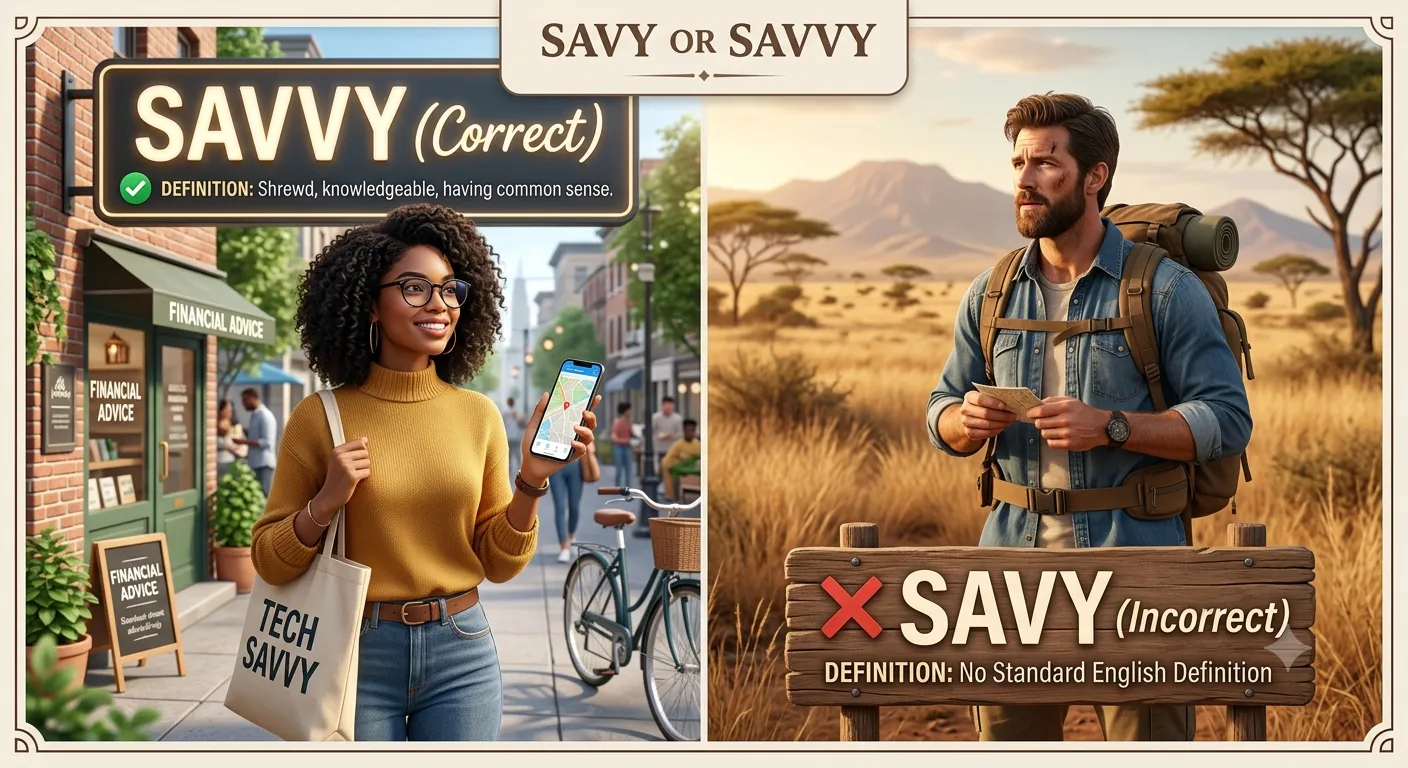
Savvy means having practical knowledge, understanding, or good judgment; it can also mean practical know-how while Savy is a common misspelling of savvy in standard English.
Quick Answer
“Savvy” is the correct spelling. “Savy” is generally an incorrect spelling and should not be used in standard English when you mean savvy.
Savvy can mean having practical knowledge, good judgment, or understanding of something. It can also be used as a noun to mean practical knowledge or understanding.
Savvy ✅: Correct
Savy ❌ :Incorrect
Quick Comparison Table
| Spelling | Correct? | Meaning | Example |
|---|---|---|---|
| Savvy | ✅ Yes | Knowledgeable, practical, or well-informed | She is savvy about digital marketing. |
| Savy | ❌ No | Generally a misspelling of savvy | ❌ She is savy about digital marketing. |
Have you ever wondered whether the correct spelling is “savy” or “savvy”?
The confusion is understandable because both forms look almost identical. However, there is an important difference: savvy is the standard English spelling, while savy is generally considered a spelling mistake.
The word savvy is commonly used to describe someone who is knowledgeable, practical, and able to understand how things work. It is especially common in expressions such as tech-savvy, business-savvy, and media-savvy.
In this guide, we’ll explain savy vs. savvy, explore the meaning and grammar of savvy, provide useful examples, and give you an easy memory trick to help you remember the correct spelling.
Which Spelling Is Correct: Savy or Savvy?
Savvy is the correct spelling.
Savvy ✅
Savy ❌
The standard spelling contains two V’s:
S-A-V-V-Y → SAVVY
The incorrect form savy contains only one V.
Therefore, if you are writing in standard English, always use savvy.
What Does “Savvy” Mean?
Savvy generally means having practical knowledge, understanding, or good judgment about something.
It can describe a person who knows how to deal with a particular situation effectively.
For example:
She is savvy about social media.
This means she understands social media well and knows how to use it effectively.
Savvy can be used in many contexts, including:
- Technology
- Business
- Finance
- Marketing
- Social media
- Politics
- Communication
- Everyday situations
Examples of “Savvy”
- He is savvy about computers.
- She is a savvy businesswoman.
- You need to be savvy when shopping online.
- The company needs a savvy marketing manager.
- Young consumers are increasingly tech-savvy.
In each example, savvy describes someone who has practical knowledge or good judgment.
Savvy as an Adjective
The most common modern use of savvy is as an adjective.
It describes someone who is knowledgeable or capable in a particular area.
Examples
- She is financially savvy.
- He is tech-savvy.
- They are business-savvy.
- My brother is social-media savvy.
- You need to be internet-savvy to avoid online scams.
Notice that savvy can appear after an adverb or as part of a compound expression.
Savvy as a Noun
Savvy can also function as a noun, although this use is less common in everyday formal writing.
As a noun, it means practical understanding, knowledge, or know-how.
Examples
- He has good business savvy.
- Her financial savvy helped the company grow.
- You need some technical savvy to use the software effectively.
Here, savvy refers to a person’s practical knowledge or ability.
Is “Savy” a Correct Word?
In standard English, savy is generally not the correct spelling when you mean savvy.
For example:
❌ She is very savy with computers.
The correct sentence is:
✅ She is very savvy with computers.
The missing second v makes savy an incorrect spelling of the standard word.
Learning Outcomes
After reading this article, you should be able to:
- Identify the correct spelling between savy and savvy.
- Understand what savvy means.
- Recognize savy as a common misspelling.
- Use savvy correctly as an adjective and noun.
- Spell savvy with its double v.
- Use common expressions such as tech-savvy and business-savvy correctly.
Grammar Rule
The standard spelling is savvy, with two V’s:
S-A-V-V-Y → savvy ✅
Savy is generally considered a misspelling when you mean savvy.
As an adjective, savvy describes someone who has practical knowledge, understanding, or good judgment.
She is savvy about online marketing.
As a noun, savvy means practical knowledge or understanding.
Her business savvy helped the company succeed.
How to Use “Savvy” as an Adjective
The most common use of savvy is as an adjective. It describes someone who understands a particular subject or situation well.
Examples
- He is savvy about technology.
- She is a savvy investor.
- They are savvy business owners.
- You need to be savvy when buying products online.
- The company hired a savvy marketing specialist.
In these examples, savvy describes a person’s knowledge or practical ability.
Common “-Savvy” Expressions
Savvy is frequently combined with another word to describe knowledge or ability in a particular area.
| Expression | Meaning | Example |
|---|---|---|
| Tech-savvy | Knowledgeable about technology | She is tech-savvy. |
| Business-savvy | Knowledgeable about business | He is business-savvy. |
| Financially savvy | Good at understanding finances | She is financially savvy. |
| Media-savvy | Skilled at dealing with the media | The politician is media-savvy. |
| Internet-savvy | Knowledgeable about using the internet | Young people are often internet-savvy. |
| Marketing-savvy | Knowledgeable about marketing | We need a marketing-savvy employee. |
Savvy vs Savy in a Sentence
| Incorrect | Correct |
|---|---|
| She is savy about technology. ❌ | She is savvy about technology. ✅ |
| He is a savy businessman. ❌ | He is a savvy businessman. ✅ |
| We need a savy investor. ❌ | We need a savvy investor. ✅ |
| She is tech-savy. ❌ | She is tech-savvy. ✅ |
| His financial savy is impressive. ❌ | His financial savvy is impressive. ✅ |
Why Is “Savy” Commonly Misspelled?
The main reason is simple: savvy is pronounced in a way that does not make the double V obvious.
When people hear the word, they may naturally write:
savy
instead of:
savvy
However, the established spelling contains two V’s.
English has many words with doubled consonants, and savvy is one of them. Learning the spelling as a whole word is more reliable than trying to spell it only from pronunciation.
A Simple Memory Trick
Use this easy trick:
Savvy has TWO V’s because savvy people know twice as much!
Or simply remember:
SAV + VY = SAVVY
When you see savy, check whether you have forgotten the second V.
Common Mistakes to Avoid
Mistake 1: Using One V
❌ Savy
✅ Savvy
The standard word always contains vv.
Mistake 2: Writing “Tech-savy”
❌ She is tech-savy.
✅ She is tech-savvy.
The compound expression also keeps the double v.
Mistake 3: Confusing “Savvy” With “Savey”
Another possible spelling error is savey. This is also not the standard spelling of savvy.
The correct form is:
Savvy ✅
One Letter Short
“Savy” is missing something a second ‘v’ and that small gap is all it takes to turn a correct word into a common typo. It’s an easy slip since the double consonant doesn’t change how the word sounds, just how it’s supposed to look on paper. The same one-letter-short pattern shows up in Excel or Excell and Surprise or Suprise, where a missing letter is the only thing separating the right spelling from the wrong one.
Savvy vs. Savy: Quick Comparison
| Feature | Savvy | Savy |
|---|---|---|
| Standard English spelling | ✅ Yes | ❌ No |
| Contains double V | ✅ Yes | ❌ No |
| Means knowledgeable/practical | ✅ Yes | ❌ No |
| Can be an adjective | ✅ Yes | ❌ No |
| Can be a noun | ✅ Yes | ❌ No |
| Used in “tech-savvy” | ✅ Yes | ❌ No |
Grammar Relay
Think of the related forms like this:
Savvy → adjective
She is savvy about business.
Savvy → noun
Her business savvy is impressive.
Tech-savvy → compound adjective
He is tech-savvy.
This makes it easy to see how savvy works in different sentences while retaining the same spelling.
Usage Tip
When using savvy, it is often useful to specify what someone is knowledgeable about.
For example:
She is savvy about finance.
or:
She is financially savvy.
Both communicate the idea that she has practical knowledge and good judgment regarding finances.
Is “Savvy” a Correct Word?
Yes. Savvy is a standard English word.
It is commonly used as an adjective to describe someone who is knowledgeable, practical, or well-informed, especially in a particular area.
Example:
She is savvy about digital marketing.
Savvy can also be used as a noun to mean practical knowledge or understanding.
His business savvy helped the company grow.
Is “Savy” a Correct Spelling?
Savy is generally not the standard spelling of the word savvy.
If you mean “knowledgeable” or “having practical understanding,” the correct form is:
Savvy ✅
not:
Savy ❌
Why Does “Savvy” Have Two V’s?
The standard spelling of the word contains a double v:
S-A-V-V-Y
The double consonant is simply part of the established spelling of the word. It is important to memorize the complete spelling rather than trying to reconstruct it from pronunciation.
Is “Tech-Savvy” or “Tech-Savy” Correct?
The correct expression is:
Tech-savvy ✅
Not:
Tech-savy ❌
For example:
Our company needs a tech-savvy employee.
The same spelling applies to other compounds:
- Business-savvy
- Financially savvy
- Media-savvy
- Marketing-savvy
- Internet-savvy
Savvy or Savy: Which One Should You Use?
If you mean knowledgeable, practical, or well-informed, always use savvy.
Savvy ✅ — Correct
Savy ❌ — Incorrect
Remember that savvy contains two V’s.
Savvy vs. Savy: Quick Review
| Feature | Savvy | Savy |
|---|---|---|
| Correct standard spelling | ✅ Yes | ❌ No |
| Meaning “knowledgeable” | ✅ | ❌ |
| Meaning “practical know-how” | ✅ | ❌ |
| Double V | ✅ | ❌ |
| Common in compound words | ✅ | ❌ |
| Used in standard English | ✅ | ❌ |
Mini Quiz
Test your knowledge:
1. Which spelling is correct?
A. Savy
B. Savvy
Answer: B. Savvy
2. Complete the sentence:
She is very ___ about social media.
A. savy
B. savvy
Answer: B. savvy
3. Which expression is correct?
A. Tech-savy
B. Tech-savvy
Answer: B. Tech-savvy
4. How many V’s does “savvy” contain?
A. One
B. Two
Answer: B. Two
5. Can “savvy” be used as a noun?
A. Yes
B. No
Answer: A. Yes
Vocabulary Corner
Savvy: Having practical knowledge, understanding, or good judgment.
Tech-savvy: Having good knowledge of or skill with technology.
Business-savvy: Having practical knowledge and good judgment in business.
Knowledgeable: Having a lot of knowledge about a particular subject.
Practical: Related to real situations and effective action rather than theory alone.
Frequently Asked Questions
Q: Is it savy or savvy?
A: The correct spelling is savvy. Savy is generally a misspelling.
Q: Does savvy have one V or two?
A: Savvy has two V’s: S-A-V-V-Y.
Q: What does savvy mean?
A: It means knowledgeable, practical, or capable of understanding and dealing with something effectively.
Q: Is savvy an adjective or a noun?
A: It can be both. As an adjective, savvy means knowledgeable or practical. As a noun, it means practical knowledge or understanding.
Q: Is tech-savvy correct?
A: Yes. Tech-savvy is the correct spelling.
Q: Is tech-savy correct?
A: No. The standard spelling is tech-savvy, with two V’s.
Q: Why do people spell savvy as savy?
A: The mistake usually occurs because the second v is easy to overlook when spelling the word from its pronunciation.
Final Verdict: Savy or Savvy?
Savvy is the correct standard English spelling. Savy is generally a misspelling and should be avoided in formal and standard writing.
Use savvy when you mean knowledgeable, practical, or well-informed:
She is a savvy entrepreneur.
And remember the spelling:
S-A-V-V-Y → SAVVY ✅
Savvy ✅ — Correct
Savy ❌ — Incorrect
Easy Memory Trick
Think:
Savvy people have TWO V’s!
That gives you a simple reminder:
SAV + VY = SAVVY
So whenever you’re unsure, don’t forget the second V.

Hi, I’m Ashley Brown, a lifelong word enthusiast with a passion for making the English language less confusing.My goal is to help readers spell with confidence and never second-guess themselves again.