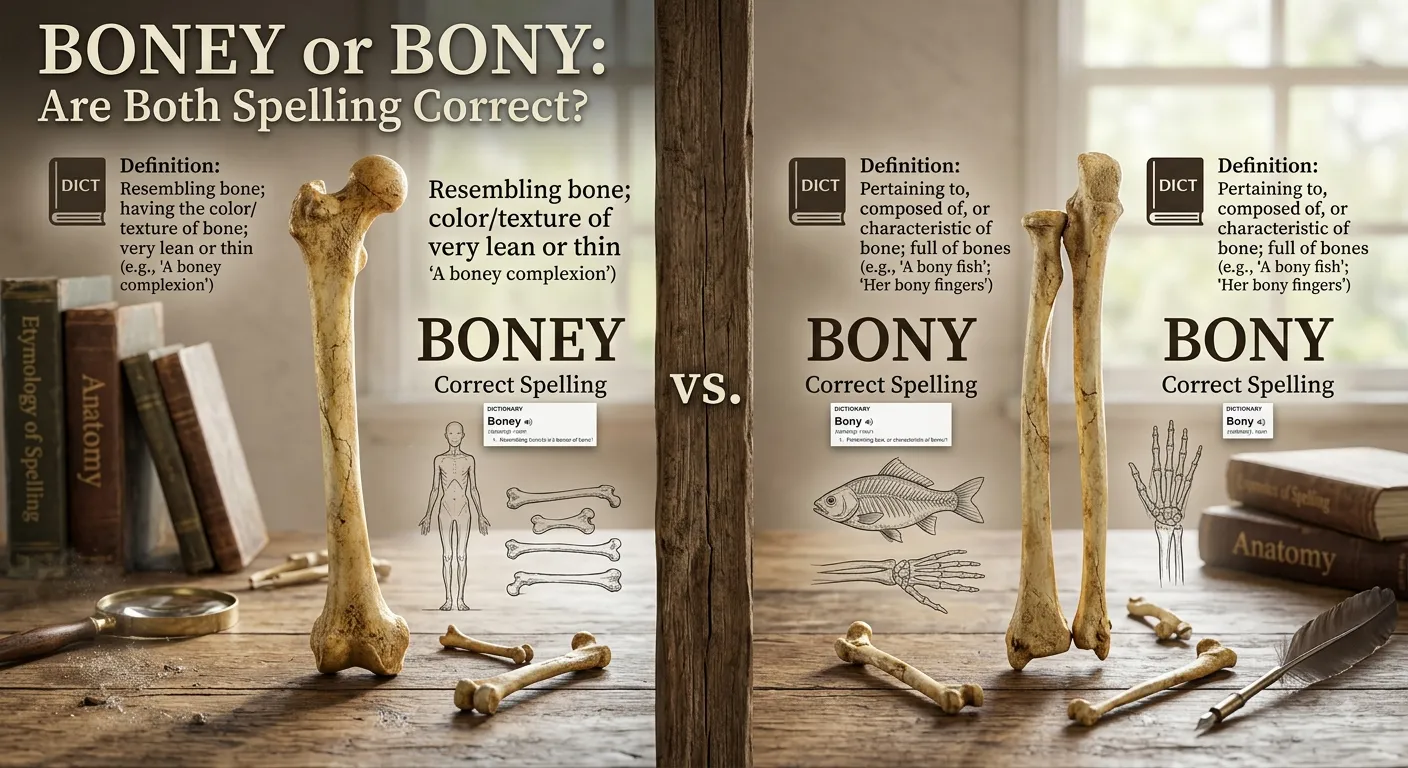
A Bony means having a lot of bones, showing bones prominently, or resembling a bone and Boney a less common spelling variant of bony, with essentially the same meaning.
Quick Answer
Both “bony” and “boney” are correct spellings, but bony is much more common and is generally the preferred form in modern English.
Both words can describe someone or something that is characterized by, resembling, or consisting of bones.
Bony ✅: Standard and much more common
Boney ✅: Correct but less common
For most everyday and formal writing, bony is the better choice.
Quick Comparison Table
| Word | Correct? | Usage | Meaning |
|---|---|---|---|
| Bony | ✅ Yes | Standard and much more common | Related to, resembling, or showing bones |
| Boney | ✅ Yes | Less common variant | Same basic meaning as bony |
Have you ever wondered whether the correct spelling is “bony” or “boney”?
Unlike many spelling comparisons where one form is simply incorrect, both bony and boney are recognized English spellings. The important difference is that bony is far more common, while boney is a less common variant.
Both forms are related to the noun bone and can describe something that is bone-like, full of bones, or showing bones clearly.
For example, if someone has very little body fat and their bones are clearly visible, you might describe them as bony. You can also describe a structure as bony when it resembles or relates to bones.
In this article, we’ll explore bony vs. boney, explain their meanings, compare their usage, and help you decide which spelling to use in your writing.
Which Spelling Is Correct: Boney or Bony?
Both spellings are correct, but bony is the more widely used form.
Bony
Bony ✅ Preferred and more common
Bony is the usual spelling in modern English.
Boney
Boney ✅ Correct but less common
Boney is an accepted spelling variant, but it appears much less frequently than bony.
Therefore, if you’re writing an article, essay, email, or other general-purpose text, bony is usually the safest choice.
What Does “Bony” Mean?
Bony is an adjective that generally means having a lot of bones, having bones that are easily seen or felt, or resembling a bone.
It can describe a person’s physical appearance, an animal, a body part, or something that has a bone-like structure.
Examples of “Bony”
- The dog has a bony frame.
- His bony hands were visible beneath his sleeves.
- The fish has a bony structure.
- She has a long, bony face.
- The doctor examined the bony structure of the joint.
In each example, bony describes something related to or characterized by bones.
What Does “Boney” Mean?
Boney has essentially the same basic meaning as bony.
It can also describe someone or something that is characterized by bones, has prominent bones, or resembles a bone.
For example:
The old horse looked boney after the long journey.
This sentence uses the less common spelling boney, but the meaning is similar to:
The old horse looked bony after the long journey.
Because bony is much more common, it is generally the preferred spelling in contemporary standard English.
Bony vs. Boney: The Main Difference
The primary difference is usage frequency, not meaning.
| Bony | Boney |
|---|---|
| Much more common | Less common |
| Standard preferred form | Accepted variant |
| Common in modern writing | Less frequently encountered |
| Same basic meaning | Same basic meaning |
The spelling difference is simply the addition of an “e”:
Bone → bony
Bone → boney
Both forms can be found in English, but bony is the form most writers should normally choose.
Why Are Both Spellings Used?
The variation comes from a common English spelling pattern.
When forming an adjective from a noun ending in e, English sometimes drops the final e before adding -y:
bone → bony
However, some words retain the e in certain variants or historical spellings:
bone → boney
This helps explain why both forms exist, although they are not equally common.
Learning Outcomes
After reading this article, you should be able to:
- Identify whether bony and boney are correct spellings.
- Understand that both forms are accepted.
- Recognize bony as the more common spelling.
- Understand the meaning of both words.
- Choose the preferred spelling for formal and everyday writing.
- Avoid incorrectly treating boney as an outright spelling error.
Grammar Rule
Both bony and boney function primarily as adjectives. They describe something that is related to, resembles, or prominently shows bones.
The main difference is usage preference:
Bony = more common and generally preferred
Boney = less common variant
For most modern English writing, bony is the better choice.
How to Use “Bony”
Use bony to describe a person, animal, body part, or structure that is characterized by prominent or visible bones.
Examples
- The stray dog looked extremely bony.
- He had long, bony fingers.
- The doctor examined the bony structure of the knee.
- The fish has a bony skeleton.
- Her face looked thin and bony.
How to Use “Boney”
Boney can be used with essentially the same meaning as bony, but it is much less common.
Examples
- The horse looked boney after months of poor nutrition.
- He had a long, boney face.
- The creature had a strange, boney appearance.
In each sentence, boney could be replaced with bony without substantially changing the meaning.
The horse looked bony after months of poor nutrition. ✅
This is generally the more natural modern spelling.
Bony vs. Boney in a Sentence
| Bony | Boney |
|---|---|
| She has bony hands. | She has boney hands. |
| The dog looked bony. | The dog looked boney. |
| He has a bony face. | He has a boney face. |
| The fish has a bony skeleton. | The fish has a boney skeleton. |
Both versions can communicate the same basic idea, but bony is considerably more common.
Which Form Is Better in Formal Writing?
For formal, academic, professional, and general-purpose writing, bony is usually the better choice.
For example:
The researchers examined the bony structure of the specimen.
This sounds more natural than:
The researchers examined the boney structure of the specimen.
Although boney is recognized as a variant, choosing the more common bony form makes your writing clearer and more conventional.
Why Is “Bony” More Common?
One reason is the standard formation of adjectives ending in -y.
The noun bone becomes:
bone + y → bony
The final e is removed before -y is added.
This pattern appears in other English words as well:
- noise → noisy
- ice → icy
- spice → spicy
- taste → tasty
Therefore, bony follows a familiar English spelling pattern.
Common Mistake: Assuming “Boney” Is Wrong
A common misconception is:
“Boney is completely incorrect.”
That’s not quite right.
Boney is a recognized spelling variant, but it is much less common than bony.
So it is better to say:
Bony = preferred/common form
Boney = less common variant
rather than simply labeling boney as an incorrect spelling.
Common Mistake: Using “Bony” and “Bonny” Interchangeably
Be careful not to confuse bony with bonny.
These are different words:
- Bony → related to or resembling bones.
- Bonny → attractive, pleasant, or beautiful; especially associated with British or Scottish usage.
For example:
The patient has a bony face. ✅
She is a bonny child. ✅
The meanings are completely different.
Bony vs. Boney vs. Bonny
| Word | Meaning | Correct? |
|---|---|---|
| Bony | Related to or resembling bones | ✅ |
| Boney | Less common variant of bony | ✅ |
| Bonny | Attractive, pleasant, or beautiful | ✅ |
This distinction is especially useful because all three words look and sound similar.
Quick Memory Trick
The easiest spelling to remember is:
BONE → BONY
Think of bony as the adjective formed directly from bone.
BONE + Y → BONY
Although boney is also accepted, bony is the spelling you will encounter much more often.
Quick Comparison: When Should You Use Each?
| Situation | Best Choice |
|---|---|
| Everyday writing | Bony |
| Academic writing | Bony |
| Professional writing | Bony |
| Medical/scientific writing | Bony |
| General description | Bony |
| Deliberately using a less common variant | Boney |
Grammar Relay
Bony → adjective
He has a bony face.
Boney → adjective
The character has a boney appearance.
Both describe a noun, but bony is the standard choice in most modern contexts.
Usage Tip
If you’re unsure which form to use, choose bony.
You won’t normally need boney unless you’re following a particular source, style, or context where that variant is intentionally used.
Bony is shorter, more common, and more recognizable to modern readers.
Boney or Bony: Common Questions
Q: Is “Bony” a Correct Word?
A: Yes. Bony is the standard and much more common spelling.
It is an adjective used to describe something that is related to bones, resembles a bone, or has prominent bones.
Example:
The child had thin, bony fingers.
Q: Is “Boney” a Correct Word?
A: Yes. Boney is also an accepted spelling variant of bony, but it is far less common.
For most modern English writing, bony is the preferred form.
Example:
The old horse looked boney after the journey.
This is understandable, but bony would generally be the more conventional choice:
The old horse looked bony after the journey.
Q: Are Bony and Boney Interchangeable?
A: In most contexts, bony and boney can express the same basic meaning.
However, they are not equally common.
Bony is the normal choice for contemporary standard English, while boney is a less common variant.
Q: Boney or Bony: Which One Should You Use?
A: If you’re writing an article, essay, school assignment, professional document, or everyday message, choose:
Bony ✅
You can use boney when a particular source or context calls for that variant, but there is usually no need to choose it over the more common bony.
Bony vs. Boney: Quick Review
| Feature | Bony | Boney |
|---|---|---|
| Correct word | ✅ Yes | ✅ Yes |
| Standard spelling | ✅ Yes | Variant |
| Meaning related to bones | ✅ Yes | ✅ Yes |
| Common in modern English | ✅ Yes | Less common |
| Preferred for general writing | ✅ Yes | Usually no |
| Adjective | ✅ Yes | ✅ Yes |
Mini Quiz
Test your knowledge:
1. Which spelling is more common in modern English?
A. Boney
B. Bony
Answer: B. Bony
2. Are both “bony” and “boney” recognized spellings?
A. Yes
B. No
Answer: A. Yes
3. Choose the preferred spelling:
The dog looked very ___ after being lost for several weeks.
A. boney
B. bony
Answer: B. Bony
4. What does “bony” describe?
A. Something related to or resembling bones
B. Something beautiful
Answer: A. Something related to or resembling bones
5. Which word means attractive or pleasant?
A. Bony
B. Bonny
Answer: B. Bonny
Vocabulary Corner
Bony: Characterized by, related to, or resembling bones.
Boney: A less common spelling variant of bony.
Bone: A hard part of the body that forms the skeleton of humans and many animals.
Bonny: Attractive, pleasing, or beautiful, especially in British and Scottish usage.
Skeletal: Relating to or resembling a skeleton or its structure.
Frequently Asked Questions
Q: Is it bony or boney?
A: Both bony and boney are recognized spellings, but bony is much more common and generally preferred.
Q: Is boney a misspelling of bony?
A: Not necessarily. Boney is an accepted variant, although it is considerably less common than bony.
Q: Which spelling should I use in formal writing?
A: Use bony. It is the more common and conventional form in modern English.
What does bony mean?
A: Bony means related to, resembling, or characterized by bones, especially when bones are prominent or easily seen.
Q: What does boney mean?
A: Boney has essentially the same meaning as bony, but it is a less common spelling variant.
Q: Are bony and bonny the same?
A: No. Bony relates to bones, while bonny means attractive, pleasant, or beautiful.
Q: Is bony an adjective?
A: Yes. Bony is primarily an adjective.
Q: Can I use boney in an essay?
A: You can, because it is a recognized variant, but bony is generally the better choice for modern formal writing.
Preferred, Not Just Different
“Bony” and “boney” aren’t a case of one being flat-out wrong both exist, but usage has clearly settled in favor of one over the other. It comes down to formality and convention rather than a hard grammar rule. That same usage-driven preference shows up in Savy or Savvy and Nickle or Nickel, where one spelling has become the accepted standard over time while the other lingers as a less-preferred choice.
Final Verdict: Boney or Bony?
Both “bony” and “boney” are correct, but they are not equally common.
Bony ✅= Standard and preferred
Boney ✅=Correct but less common
For most modern writing, bony is the safest and most natural choice.
Remember:
BONE → BONY
So, if you’re unsure, go with bony.
And don’t confuse it with bonny, which has a completely different meaning.
Easy Memory Trick
Think:
BONE + Y = BONY
The word bony comes naturally from bone, making it the easiest form to remember.
Bony = related to bones 🦴
Boney = less common variant
Bonny = attractive or pleasant

Amna Akhtar is a writer dedicated to making English easier to understand. She creates research-informed guides on grammar, vocabulary, spelling differences, and commonly confused words, combining careful research with clear, practical explanations. She is also the co-author of the peer-reviewed research article “Determinants of Jobs Satisfaction of Female Teachers: An Evidence from District Hafizabad, Pakistan,” published in the Journal of Education and Social Studies (2021).