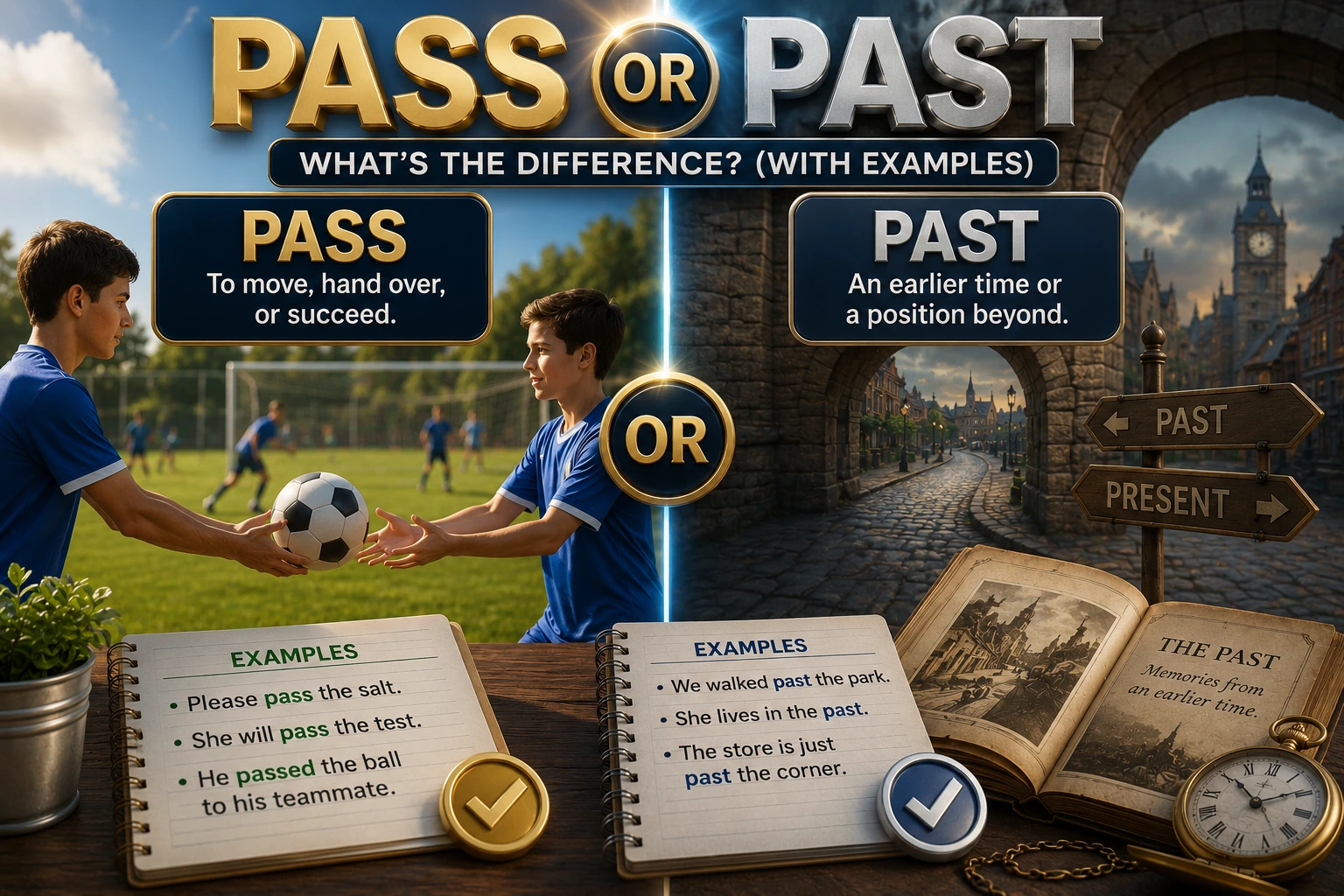
Pass is usually a verb meaning to move by, hand over, or succeed, while past refers to an earlier time or a position beyond something.
Quick Answer
Pass and past may look similar, but they have different meanings and grammatical functions. Pass is usually a verb that means to move by, go beyond, succeed, or hand something to someone. Past can be a noun, adjective, adverb, or preposition, and it refers to an earlier time or movement beyond a particular point.
Examples:
- Please pass the salt. ✅
- I hope I pass my driving test. ✅
- We walked past the library. ✅
- Let’s leave the past behind. ✅
Quick Tip: If you’re talking about an action, use pass. If you’re referring to time, position, or direction, use past.
What Is the Difference Between Pass and Past?
The difference between pass and past depends on how they’re used in a sentence.
- Pass is most commonly a verb. It describes an action, such as moving by something, giving an object to someone, or succeeding in a test.
- Past is never used as a verb. Instead, it refers to a previous time, a position beyond something, or movement beyond a place. Depending on the sentence, it can function as a noun, adjective, adverb, or preposition.
Compare these examples:
- ✅ Please pass me the remote.
- ✅ She worked hard to pass the exam.
- ✅ We drove past the supermarket.
- ✅ You should learn from the past.
A simple way to remember the difference is:
Pass = Action
Past = Time or Position
What Does “Pass” Mean?
Pass is primarily a verb that means to move beyond something, hand something to another person, succeed in a test, or allow something to continue from one place to another.
It is one of the most versatile verbs in English and appears in many everyday expressions.
Read more: It’s or Its? Difference, Grammar Rules & Easy Examples
Common Meanings of Pass
1. To Move By or Go Beyond
Examples:
- We passed the museum on our way home.
- A train passed the station without stopping.
- She watched the cars pass by.
2. To Hand Something to Someone
Examples:
- Please pass the sugar.
- Could you pass me your notebook?
- He passed the ball to his teammate.
3. To Succeed
Examples:
- She passed the final exam.
- I hope you pass your interview.
- He studied hard to pass his driving test.
4. To Spend or Go Through Time
Examples:
- We passed the evening watching movies.
- Time seemed to pass quickly.
- The days passed slowly during the holidays.
Common Expressions with “Pass”
- Pass an exam
- Pass the ball
- Pass the salt
- Pass away
- Pass by
- Pass on
- Pass through
- Pass the time
Tip: If the word describes something happening or being done, pass is usually the correct choice.
What Does “Past” Mean?
Unlike pass, past can serve several different grammatical roles. It can be a noun, adjective, adverb, or preposition, but it is never a verb.
Its core meaning relates to earlier time or a position beyond a particular point.
1. Past as a Noun
As a noun, past means the time before the present.
Examples:
- We should learn from the past.
- Her past shaped who she is today.
- Let’s not dwell on the past.
2. Past as a Preposition
As a preposition, past means beyond or by a particular place or point.
Examples:
- We walked past the school.
- The bus drove past my house.
- She ran past the finish line.
3. Past as an Adjective
As an adjective, past describes something that has already happened.
Examples:
- During the past year, sales increased significantly.
- We reviewed past exam papers.
- His past experiences made him stronger.
4. Past as an Adverb
As an adverb, past describes movement beyond a point.
Examples:
- The car sped past.
- He hurried past without saying hello.
- Everyone walked past quietly.
Common Expressions with “Past”
- The past
- Past experience
- Past tense
- Walk past
- Drive past
- Run past
- Half past three
- Past midnight
Tip: If you’re talking about time, history, or moving beyond something, past is almost always the correct word.
What Major Dictionaries Say
Major English dictionaries agree that pass and past have different meanings and grammatical functions, even though they’re often confused because they sound alike.
Cambridge Dictionary
Cambridge Dictionary defines pass as a verb meaning to move by, go beyond, hand something to someone, or succeed in a test. It defines past as referring to a previous time or a position beyond a particular point, depending on how it’s used.
Takeaway: Cambridge confirms that pass is mainly an action word, while past relates to time or position.
Merriam-Webster
Merriam-Webster defines pass as to move, proceed, transfer, or succeed. It defines past as earlier than the present time or beyond a place or point.
Takeaway: Merriam-Webster clearly distinguishes pass as a verb from past, which performs several other grammatical functions.
Oxford English Dictionary
Oxford Dictionary explains that pass means to go by, hand over, or succeed, while past refers to time gone by or movement beyond a specific point.
Takeaway: Oxford emphasizes that although the words sound similar, they cannot usually be substituted for one another.
Dictionary Consensus
Leading English dictionaries agree that:
- Pass is primarily a verb describing an action.
- Past is never a verb.
- Past refers to earlier time, position, or movement beyond a point.
- Understanding each word’s grammatical role is the easiest way to avoid confusion.
Pass vs. Past: Side-by-Side Comparison
| Feature | Pass | Past |
|---|---|---|
| Part of Speech | Mainly a verb (can also be a noun in some contexts) | Noun, adjective, adverb, or preposition |
| Primary Meaning | To move by, hand over, succeed, or go beyond | Earlier time or a position beyond something |
| Describes | An action | Time, direction, position, or a previous period |
| Common Usage | Everyday actions | Time expressions and locations |
| Can Be a Verb? | ✅ Yes | ❌ No |
| Example | Please pass the book. | We walked past the park. |
Quick Rule: If you’re describing an action, use pass. If you’re talking about time or location, use past.
When to Use “Pass”
Use pass when you mean to perform an action such as moving beyond something, handing something to another person, succeeding in a test, or allowing something to continue.
Choose pass when you’re talking about:
- Moving by a place or person
- Giving something to someone
- Passing an exam or test
- Spending time
- Approving a law or motion
Examples
- Please pass me the water bottle.
- I hope I pass my driving test.
- We passed several restaurants on the way home.
- Time seems to pass quickly when you’re having fun.
- Parliament voted to pass the new law.
Common Phrases
- Pass an exam
- Pass the ball
- Pass the salt
- Pass away
- Pass by
- Pass through
- Pass on
- Pass the time
Remember: If the word shows something being done, pass is almost always the correct choice.
When to Use “Past”
Use past when referring to an earlier time, a location beyond something, or movement beyond a specific point.
Choose past when you’re talking about:
- Previous events
- History
- Moving beyond a place
- Time expressions
- Position or direction
Examples
- We walked past the bakery.
- Let’s learn from the past.
- It’s half past eight.
- She drove past my office this morning.
- During the past month, sales increased by 15%.
Common Phrases
- The past
- Past experience
- Past tense
- Walk past
- Drive past
- Run past
- Half past
- Past midnight
Remember: If you’re referring to time, history, or position, use past.
Common Mistakes to Avoid
Because pass and past are pronounced similarly, they’re frequently confused in writing. Here are some of the most common mistakes.
| ❌ Incorrect | ✅ Correct | Why? |
|---|---|---|
| We walked pass the museum. | We walked past the museum. | Past is the correct preposition for movement beyond a place. |
| I hope I past the exam. | I hope I pass the exam. | Pass is the verb meaning “to succeed.” |
| Please past me the salt. | Please pass me the salt. | You’re asking someone to hand you something. |
| She drove pass my house. | She drove past my house. | Past indicates movement beyond a location. |
| It’s half pass three. | It’s half past three. | Past is used when telling time. |
Commonly Confused Expressions
| ❌ Wrong | ✅ Right |
|---|---|
| Pass the park | Walk past the park |
| Past the exam | Pass the exam |
| Past me the pen | Pass me the pen |
| Half pass five | Half past five |
| Drive pass the station | Drive past the station |
Tip: Ask yourself, “Is this an action or a time/location?”
If it’s an action, choose pass. If it’s about time or position, choose past.
Memory Trick to Remember the Difference
Here’s a simple trick that makes choosing the right word much easier.
Think of This Rule
- Pass = Perform an action
- Past = Previous time or beyond a place
Easy Memory Tip
The word pass contains “ss”, just like:
- Success
- Passing a test
If you’re doing something, you’ll usually need pass.
The word past ends with “t”, which can remind you of:
- Time
- Then
- Yesterday
These all relate to the past.
Remember This Phrase
Pass the ball. Walk past the ball.
The first sentence describes an action. The second describes movement beyond a place.
This simple contrast can help you remember the difference every time.
Examples of Pass and Past in Sentences
Seeing both words in context makes the distinction much clearer.
Examples with Pass
- Please pass the pepper.
- She studied hard to pass the final exam.
- The train will pass through three cities.
- We watched the hours pass slowly.
- He managed to pass all his subjects.
Examples with Past
- We walked past the old library.
- Don’t let the past control your future.
- It’s quarter past ten.
- She drove past without stopping.
- During the past decade, technology has changed rapidly.
Pass vs. Past in Context
- ✅ Please pass me your notebook.
- ✅ We walked past the coffee shop.
- ✅ I hope I pass tomorrow’s interview.
- ✅ The mistakes belong to the past.
These examples show that pass is used for actions, while past refers to time, direction, or position.
Practice Quiz
Choose the correct word: pass or past.
1. Please ______ me the newspaper.
- A) pass
- B) past
✅ Answer: A) pass
2. We walked ______ the post office on our way home.
- A) pass
- B) past
✅ Answer: B) past
3. I hope I ______ my final exam.
- A) pass
- B) past
✅ Answer: A) pass
4. It’s half ______ seven.
- A) pass
- B) past
✅ Answer: B) past
5. The bus will ______ through the city center.
- A) pass
- B) past
✅ Answer: A) pass
6. We should learn from the ______ instead of repeating the same mistakes.
- A) pass
- B) past
✅ Answer: B) past
Read more:Who or Whom: What’s the Difference? Grammar Rules, Examples
Grammar Relay
📚 Vocabulary Corner
Synonyms of Pass (Verb)
- Hand
- Proceed
- Succeed
Synonyms of Past
- Previous
- Former
- Gone by
Antonyms
Pass
- Fail
- Stop
- Remain
Past
- Present
- Current
- Future
Idioms with “Pass”
1. Pass the buck
Meaning: To shift responsibility to someone else.
Example: Instead of fixing the problem, he passed the buck to his colleague.
2. Pass with flying colors
Meaning: To succeed with excellent results.
Example: She passed the interview with flying colors.
3. Let bygones be bygones
Meaning: To forget past disagreements or mistakes and move on.
Example: After years of arguing, they decided to let bygones be bygones.
Proverb
“The past is a place of reference, not a place of residence.”
Meaning: Learn from previous experiences, but don’t let them prevent you from moving forward.
💡 Grammar Tip of the Day
The easiest way to tell these words apart is to identify their job in the sentence.
- Pass is usually a verb, so it expresses an action.
- Past is never a verb. It functions as a noun, adjective, adverb, or preposition and relates to time or position.
Easy Formula
✅ Pass the ball. (action)
✅ Pass the exam. (action)
✅ Walk past the school. (position)
✅ Learn from the past. (earlier time)
Remember: Pass = Action. Past = Time or Position.
🚀 Next Lesson
Continue improving your English with these commonly confused word guides:
- Patient or Patience: What’s the Difference?
- Losing or Loosing: Which Word Is Correct?
- Breath or Breathe: What’s the Difference?
Frequently Asked Questions (FAQs)
Q: Is it pass or past?
A: It depends on the sentence. Use pass for actions such as handing something over, moving by, or succeeding. Use past when referring to earlier time, movement beyond a place, or a previous period.
Q: What is the difference between pass and past?
A: Pass is mainly a verb that describes an action. Past can be a noun, adjective, adverb, or preposition and relates to time or position.
Q: Is past ever a verb?
A: No. Past is never used as a verb. If you need a verb, such as moving beyond something or succeeding in an exam, use pass.
Q: Which is correct: “pass the exam” or “past the exam”?
A: The correct phrase is pass the exam because pass means to succeed.
Q: Is it “walk pass” or “walk past”?
A: The correct expression is walk past because past is the preposition that means “beyond.”
Q: How can I remember the difference between pass and past?
A: Use this simple memory trick:
Pass = Action.
Past = Time or Position.
If you’re doing something, choose pass. If you’re talking about time or location, choose past.
Key Takeaways
- Pass is mainly a verb that means to move by, hand over, or succeed.
- Past is never a verb. It refers to earlier time or a position beyond something.
- Use pass for actions such as passing an exam or passing the salt.
- Use past for expressions like the past, walk past, and half past three.
- When in doubt, remember: Pass = Action. Past = Time or Position.
Final Verdict
Although pass and past sound alike, they have different meanings and grammatical roles. Pass is the word you’ll use for actions like handing something to someone, moving by, or succeeding in a test. Past refers to time that has already gone by or movement beyond a place and can never be used as a verb.
A quick way to remember the difference is:
Pass = Action.
Past = Time or Position.
Once you know each word’s role in a sentence, choosing the correct one becomes simple and natural.
Read more: Losing or Loosing: Which Word Is Correct? (2026)

“I am Paul Emerson, a language writer dedicated to untangling the English language’s trickiest spelling dilemmas. With a sharp eye for detail, I break down confusing word pairs into clear, simple comparisons anyone can grasp.”