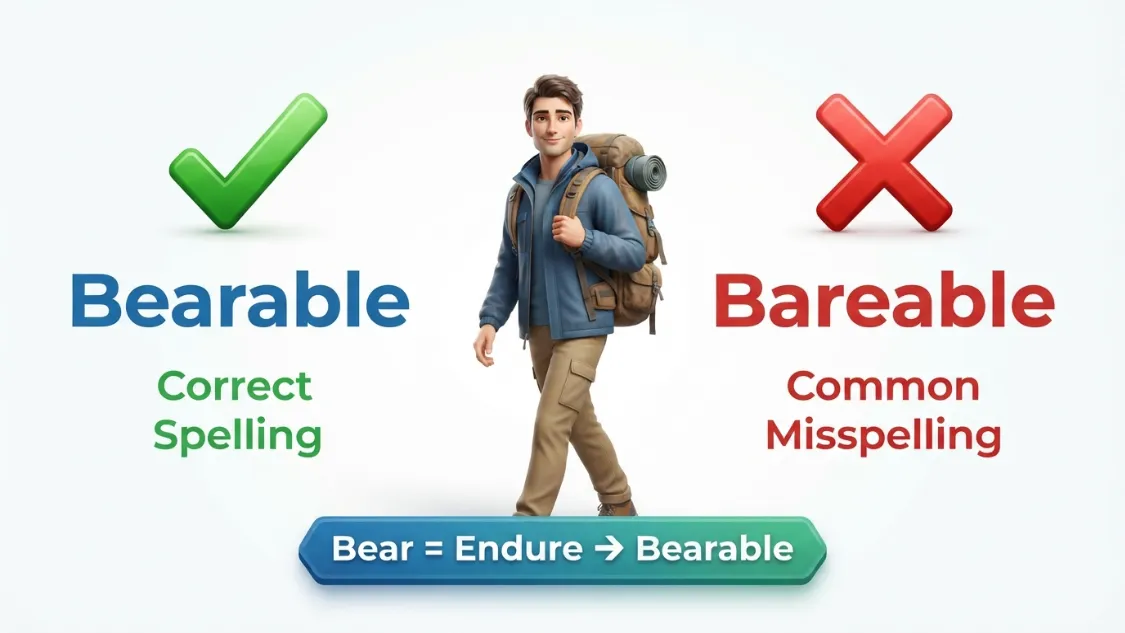
Bearable: Able to be endured, tolerated, or managed without excessive difficulty or discomfort. Bareable: A common misspelling of bearable and not a standard English word.
Quick Answer
✅ Bearable is the correct spelling.
❌ Bareable is a misspelling and should be avoided in formal and everyday writing.
Easy way to remember
Think of the verb bear, meaning to carry, endure, or tolerate.
If something is bearable, you can bear it.
Quick Comparison Table
| Word | Correct? | Meaning |
|---|---|---|
| Bearable | ✅ Yes | Able to be endured or tolerated |
| Bareable | ❌ No | Not a standard English word |
The correct spelling is bearable. It means able to be endured, tolerated, or put up with. The spelling bareable is a common misspelling and is not recognized as a standard English word.
In this guide, you’ll learn the difference between bareable and bearable, why people mix them up, and how to remember the correct spelling every time.
What Does Bearable Mean?
Bearable is an adjective that describes something that is not too difficult, painful, unpleasant, or uncomfortable to endure.
Examples
- The headache became bearable after I took some medicine.
- The weather was hot but still bearable.
- His workload was heavy but bearable.
- The long journey became more bearable with good music.
- Although the noise was annoying, it was still bearable.
Is Bareable a Real Word?
No.
Bareable is not listed as a standard English word in major dictionaries. Most spell-checkers and grammar tools identify it as an error and suggest bearable instead.
People usually write bareable because they confuse it with the word bare, which means uncovered, exposed, or without clothing.
For example:
- bare feet
- bare walls
- bare hands
Since bare has nothing to do with enduring or tolerating something, it does not form the adjective bearable.
Why Do People Confuse Bareable and Bearable?
There are three main reasons.
1. Similar pronunciation
Bare and bear are homophones, meaning they sound exactly the same in English.
This makes it easy to choose the wrong spelling when writing.
2. Similar appearance
The words differ by only one letter, so many people type bareable without noticing the mistake.
3. Auto-correct doesn’t always help
If you’re typing quickly or using informal messaging apps, the error may go unnoticed until you proofread your writing.
The Origin of Bearable
The word bearable comes from the verb bear, which has existed in English for centuries.
In this context, bear means:
- to endure
- to tolerate
- to carry
- to withstand
The suffix -able means capable of.
So:
Bear + able = Bearable
Meaning:
Capable of being endured or tolerated.
Why Bearable Is the Correct Spelling
The meaning of bearable comes directly from the verb bear.
Examples:
- bear pain
- bear responsibility
- bear hardship
- bear criticism
If you can bear something, it is bearable.
The word bare means something completely different, so bareable does not follow English word formation rules.
Memory Trick
Here’s an easy way to remember the correct spelling.
Bear = endure
Bearable = able to endure
Imagine a bear carrying a heavy backpack through the forest.
If the bear can carry it, the load is bearable.
This simple image helps connect bear with bearable.
When Should You Use Bearable?
Use bearable whenever you mean:
- tolerable
- manageable
- endurable
- not too painful
- not too difficult
Common contexts
| Situation | Correct Word |
|---|---|
| Pain | Bearable |
| Heat | Bearable |
| Stress | Bearable |
| Noise | Bearable |
| Workload | Bearable |
| Discomfort | Bearable |
Is Bearable British or American English?
Unlike words such as colour/color or organise/organize, bearable has the same spelling in both British and American English.
| English Variety | Preferred Spelling |
|---|---|
| British English | Bearable |
| American English | Bearable |
| Canadian English | Bearable |
| Australian English | Bearable |
Key takeaway: There is no regional spelling difference. Bearable is the correct spelling worldwide.
What Major Dictionaries Say
Leading English dictionaries agree that bearable is the standard spelling.
| Dictionary | Preferred Spelling |
|---|---|
| Oxford English Dictionary | Bearable |
| Cambridge Dictionary | Bearable |
| Merriam-Webster | Bearable |
| Collins English Dictionary | Bearable |
| Dictionary.com | Bearable |
None of these major dictionaries recognize bareable as a standard English word.
Pronunciation Guide
Bearable is pronounced:
/ˈbeə.rə.bəl/ (British English)
/ˈber.ə.bəl/ (American English)
Simple pronunciation: BEAR-uh-buhl
Notice that the first syllable sounds exactly like the animal bear.
Bear vs. Bare
Many spelling mistakes happen because bear and bare sound the same but have different meanings.
| Word | Meaning | Example |
|---|---|---|
| Bear | To endure, tolerate, carry, or support | I can’t bear the loud noise. |
| Bare | Uncovered, exposed, or empty | She walked with bare feet. |
Since bearable comes from the verb bear, it is always spelled with bear-, not bare-.
Common Mistakes
Avoid these common errors.
| Incorrect | Correct | Why? |
|---|---|---|
| The pain was bareable. | The pain was bearable. | Bearable is the correct word. |
| The weather became bareable. | The weather became bearable. | It means “able to be endured.” |
| His workload is bareable. | His workload is bearable. | Derived from bear, not bare. |
| Bareable is listed in dictionaries. | Bearable is the dictionary word. | Bareable is a misspelling. |
Examples of Bearable in Sentences
- The pain became bearable after resting for a few hours.
- The room was warm but still bearable.
- Thanks to the air conditioner, the summer heat was bearable.
- Her supportive friends made the difficult time more bearable.
- The long meeting was bearable because it was well organized.
- Even though the backpack was heavy, it was bearable.
- The traffic noise was annoying but bearable.
Examples of Incorrect Usage
These examples contain the common spelling mistake.
❌ The cold weather was bareable.
✅ The cold weather was bearable.
❌ His shoulder pain became bareable after treatment.
✅ His shoulder pain became bearable after treatment
❌ The exam stress was bareable.
✅ The exam stress was bearable.
Bearable vs. Bareable at a Glance
| Question | Answer |
|---|---|
| Which spelling is correct? | Bearable |
| Is bareable a real English word? | No |
| Which spelling appears in dictionaries? | Bearable |
| Which spelling should you use in writing? | Bearable |
| Are there British and American differences? | No |
Did You Know?
💡 Interesting fact: The verb bear has been part of English for more than 1,000 years. In addition to meaning “to endure,” it can also mean to carry, to support, or to produce, depending on the context. The adjective bearable developed from this long-standing meaning of being able to endure something.
Mini Quiz
Test your understanding by choosing the correct answer.
1. Which spelling is correct?
- A. Bareable
- ✅ B. Bearable
2. What does bearable mean?
- A. Without covering
- ✅ B. Able to be endured or tolerated
- C. Easy to see
3. Which sentence is correct?
- A. The pain was bareable.
- ✅ B. The pain was bearable.
4. Which word is bearable derived from?
- A. Bare
- ✅ B. Bear
Score Guide
- 4/4: Excellent! You know the correct spelling.
- 2–3/4: Good job! Review the Bear vs. Bare section.
- 0–1/4: Read the guide again to avoid this common spelling mistake.
Practice Guide
Use bearable whenever you mean able to be endured or tolerated.
| Situation | Correct Word |
|---|---|
| Physical pain | Bearable |
| Hot weather | Bearable |
| Loud noise | Bearable |
| Heavy workload | Bearable |
| Emotional stress | Bearable |
| Long journey | Bearable |
Quick Tip
Ask yourself:
Can I bear (endure) it?
If the answer is yes, the correct spelling is bearable.
Frequently Asked Questions (FAQs)
Q: Is bareable a real word?
A: No. Bareable is a common misspelling and is not recognized as a standard English word.
Q: Which spelling should I use?
A: Always use bearable when describing something that can be endured or tolerated.
Q: Why do people write bareable?
A: Because bear and bare sound the same. They are homophones, but they have different meanings.
Q: Is bearable used in both British and American English?
A: Yes. Bearable is the standard spelling in all major varieties of English.
Q: What is the opposite of bearable?
A: Common opposites include unbearable, intolerable, and insufferable.
Q: Can bearable describe emotions as well as physical pain?
A: Yes. It can describe anything that can be tolerated, including pain, stress, sadness, heat, noise, or difficult situations.
Grammar Relay Corner
Synonyms of Bearable
- Tolerable
- Endurable
- Manageable
- Acceptable
- Livable
- Sustainable
- Moderate
- Reasonable
Antonyms of Bearable
- Unbearable
- Intolerable
- Insufferable
- Impossible
- Excruciating
- Extreme
- Agonizing
- Overwhelming
Word Family
| Word | Part of Speech | Meaning |
|---|---|---|
| Bear | Verb | To endure, tolerate, or carry |
| Bearable | Adjective | Able to be endured |
| Unbearable | Adjective | Impossible to endure |
| Bearing | Noun/Verb | Direction, posture, or carrying |
Idiom Connection
Bear with me
Meaning: Please be patient with me.
Example:
Bear with me while I finish this report.
Note: This idiom uses bear (endure), not bare.
Proverb
What cannot be cured must be endured.
This proverb reminds us that some difficult situations become bearable when we accept and cope with them.
Key Takeaways
- ✅ Bearable is the only correct spelling.
- ❌ Bareable is a misspelling.
- ✅ Bearable comes from the verb bear, meaning to endure or tolerate.
- ✅ There is no British vs. American spelling difference.
- ✅ Major dictionaries recognize bearable but not bareable.
- ✅ Use bearable whenever something can be endured, tolerated, or managed.
Conclusion
Although bareable and bearable sound the same, only bearable is correct in standard English. The word comes from the verb bear, meaning to endure or tolerate, so bearable describes something that can be endured without being too difficult or painful.
The spelling bareable is a common mistake caused by confusing bear with bare, two words that sound alike but have different meanings. Whether you’re writing an email, essay, blog post, or social media update, choosing bearable will ensure your writing is clear, accurate, and professional.
Related Article
Sergeant or Sargent: What’s the Difference?

Amna Akhtar is a writer dedicated to making English easier to understand. She creates research-informed guides on grammar, vocabulary, spelling differences, and commonly confused words, combining careful research with clear, practical explanations. She is also the co-author of the peer-reviewed research article “Determinants of Jobs Satisfaction of Female Teachers: An Evidence from District Hafizabad, Pakistan,” published in the Journal of Education and Social Studies (2021).