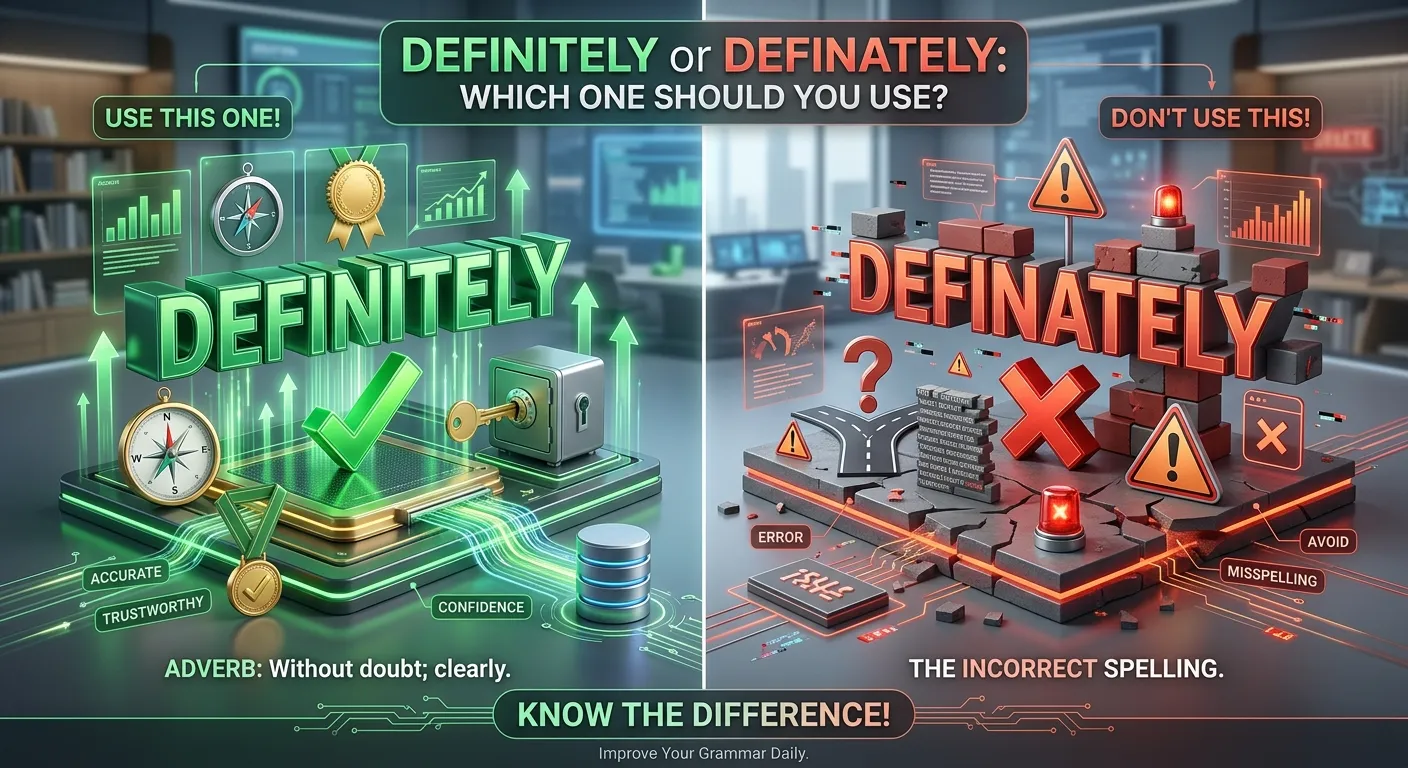
Definitely: Without any doubt; certainly, or surely.
Quick Answer
Definitely is the correct spelling. Definately is a common misspelling and should not be used in standard English.
Definitely or Definately: Which Is Correct?
The correct spelling is definitely.
❌ Definately : incorrect
✅ Definitely: correct
Definitely is an adverb meaning “without any doubt,” “certainly,” or “surely.”
Quick Comparison
| Spelling | Correct? | Meaning | Example |
| Definitely | ✅ Yes | Without any doubt; certainly | I will definitely call you tomorrow. |
| Definately | ❌ No | Common misspelling of definitely | ❌ I will definately call you tomorrow. |
What Does “Definitely” Mean?
Definitely means without doubt or uncertainty; certainly. It can also be used as a strong way to say “yes” in conversation.
Examples:
- I will definitely finish the work today.
- She is definitely coming to the party.
- “Would you like some coffee?” “Definitely!”
- This is definitely the right answer.
Etymology of “Definitely”
Definitely comes from the Latin definitus, meaning “defined” or “limited.” It entered English through definite and developed into the adverb definitely, meaning “in a definite or certain way.”
Why Is “Definately” Wrong?
Definately is not the standard spelling of the word. The mistake usually happens because the pronunciation does not make every letter obvious.
The correct spelling is:
de-finite-ly → definitely
A useful way to remember it is to notice the word finite inside definitely:
de + finite + ly = definitely
Merriam-Webster specifically recommends remembering that definitely contains the word finite as a spelling aid.
Common Spelling Mistake
Many writers accidentally remove the i after the n:
❌ definately
✅ definitely
Think:
finite → definitely
not:
finate → definately
How to Pronounce “Definitely”
Definitely is pronounced approximately:
/ˈdef.ɪ.nət.li/ in British English
/ˈdef.ə.nət.li/ in American English
It sounds roughly like:
DEF-uh-nit-lee
The spelling may look longer than the way the word sounds, which is one reason learners sometimes misspell it.
“Definitely” in a Sentence
Here are some natural examples:
- I will definitely be there on time.
- She definitely knows the answer.
- We should definitely visit that museum.
- He is definitely the right person for the job.
- “Are you coming with us?” “Definitely!”
Definitely vs. Definately: The Grammar Rule
Definitely is an adverb. It is commonly used to modify a verb, adjective, or another adverb and express certainty or strong agreement.
For example:
- She will definitely come.
- That is definitely true.
- I definitely agree.
The spelling definately is simply an incorrect spelling of the adverb definitely.
A Simple Trick to Remember “Definitely”
Use this memory trick:
Definitely has “finite” in it.
DE + FINITE + LY = DEFINITELY
If you remember finite, you are much less likely to write definately.
Another quick reminder:
There is “finite” in definitely.
So remember:
✅ definitely
❌ definately
Learning Outcomes
After reading this guide, you should be able to:
- Identify definitely as the correct spelling.
- Recognize definately as a common misspelling.
- Understand the meaning and grammatical use of definitely.
- Remember the spelling using the finite trick.
- Use definitely correctly in sentences.
Dictionary Note
Merriam-Webster defines definitely as an adverb meaning “in a definite way” or in a way free from uncertainty. Cambridge Dictionary similarly defines it as meaning “without any doubt” and lists certainly and decidedly among its synonyms.
Author/Reviewer: Written and reviewed for spelling accuracy, English usage, and learner-friendly clarity.
Frequently Asked Questions
Q: Is “definately” a correct spelling?
A: No. Definately is a common misspelling. The correct spelling is definitely.
Q: Is it “definitely” or “definately”?
A: It is definitely. The spelling definately is incorrect.
Q: What is the easiest way to remember “definitely”?
A: Remember that definitely contains the word finite:
de + finite + ly = definitely.
Q: What does “definitely” mean?
A: Definitely means without any doubt, certainly, or surely.
Q: Is “definitely” an adverb?
A: Yes. Definitely is an adverb used to express certainty or strong agreement.
Q: Can I use “definitely” at the beginning of a sentence?
A: Yes. For example:
Definitely, we should check the answer again.
However, in everyday writing, it is often more natural to place it near the verb:
We should definitely check the answer again.
Quick Practice
Choose the correct spelling:
- I will definitely / definately come tomorrow.
- She is definitely / definately the best candidate.
- Definitely / Definately, I agree with you.
Answers:
- definitely
- definitely
- Definitely
One of English’s Most Googled Typos
“Definately” is one of the most searched misspellings in English, and it happens because the word doesn’t sound the way it’s spelled that middle section sounds like “ate,” pulling writers away from the correct “definite” base hiding inside “definitely.” The word isn’t related to “finite” at all, despite how often the two get mixed up in people’s minds. This same kind of pronunciation-driven mistake shows up in Writing or Writting and Throught or Through, where the way a word sounds quietly overrides how it’s actually built.
Definitely or Definately: Final Verdict
Definitely is the only correct spelling in standard English.
Use definitely when you mean certainly, surely, or without any doubt.
Correct: I will definitely finish it today.
Incorrect: I will definately finish it today.
If you often confuse these spellings, remember the word finite hidden inside definitely:
de + finite + ly = definitely.

Rose Vault is an English language author who specializes in spelling comparisons, commonly confused words, and grammar. She creates clear, well-researched content that helps readers improve their writing and use English with confidence. Her goal is to make language learning simple, accurate, and accessible for everyone.