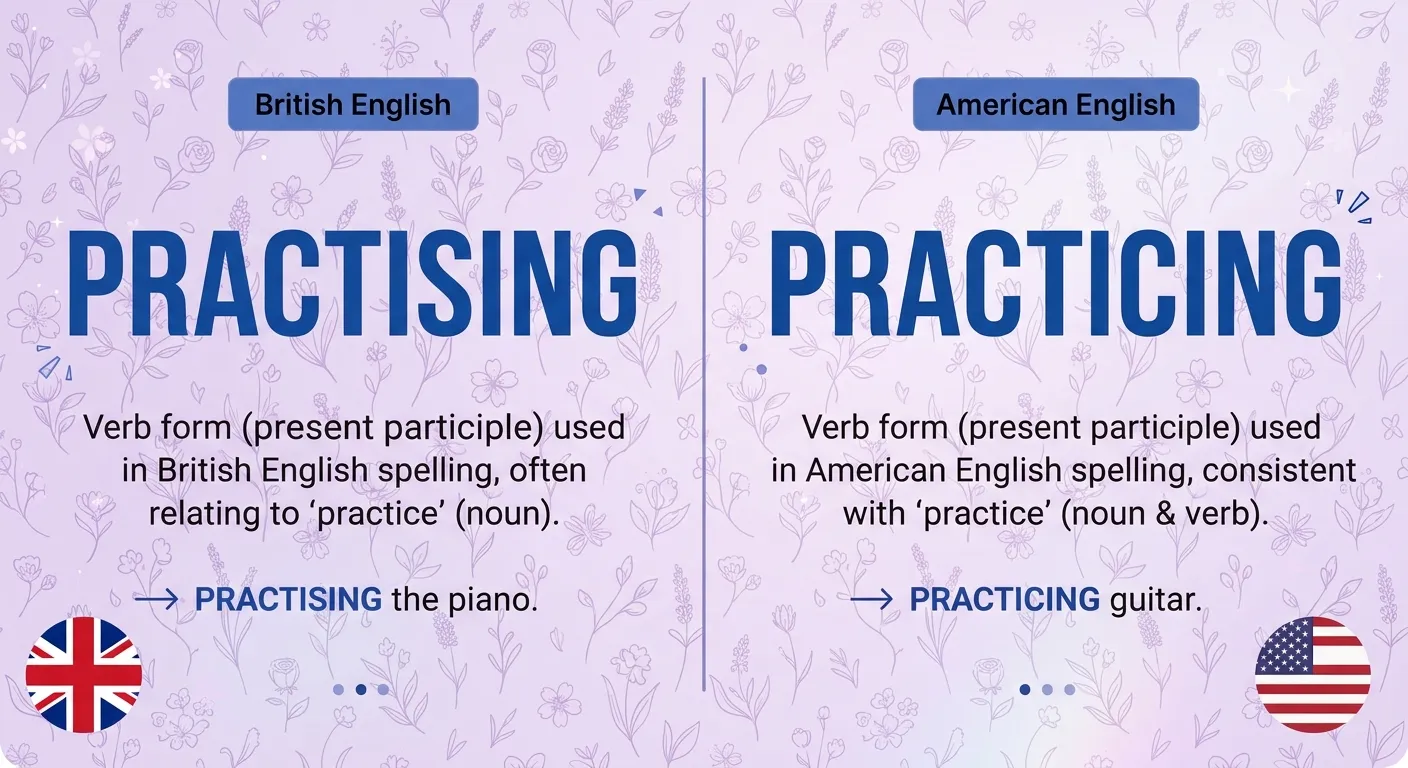
Practising and practicing are both correct spellings, but the preferred spelling depends on the variety of English you use. Practising is the standard British English meaning to repeatedly perform an activity to improve a skill., while practicing is used as both the verb and adjective/noun form in American English.
Quick Answer
- 🇬🇧 British English: practising is the verb form.
- 🇺🇸 American English: practicing is used for the verb.
- Practising is correct when following British English spelling rules.
- Practicing is correct in American English.
- The difference comes from the British distinction between practice (noun) and practise (verb).
Example:
🇬🇧 She is practising the piano every day.
🇺🇸 She is practicing the piano every day.
Both sentences have the same meaning.
Quick Comparison Table
| Spelling | English Variety | Word Type | Example |
|---|---|---|---|
| practising | British English | Verb | She is practising her pronunciation. |
| practicing | American English | Verb | She is practicing her pronunciation. |
| practice | British & American English | Noun | Regular practice improves your skills. |
| practise | British English | Verb | You should practise every day. |
Are Practising and Practicing Both Correct?
Yes. Practising and practicing are both correct, but they follow different spelling conventions.
The main difference is between British English and American English.
British English generally uses:
- practice → noun
- practise → verb
- practising → -ing form of the verb
- practised → past form of the verb
American English normally uses practice for both the noun and verb:
- practice → noun
- practice → verb
- practicing → -ing form
- practiced → past form
So, if your writing follows British English, use practising. If you are writing in American English, use practicing.
British English: Practising
In British English, practising is the present participle and gerund form of the verb practise.
The verb practise means to do something repeatedly in order to improve your ability or skill.
Examples
- I am practising my English pronunciation.
- She is practising the piano.
- They are practising for the competition.
- He spends an hour practising his speech.
- We are practising new vocabulary words.
British English Word Family
| Form | Example |
|---|---|
| practice — noun | Practice makes progress. |
| practise — verb | You should practise regularly. |
| practising — verb form | She is practising today. |
| practised — past form | He practised for two hours. |
American English: Practicing
In American English, practicing is the standard spelling of the -ing form.
American English does not normally distinguish between practice as a noun and practice as a verb.
Examples
- I am practicing my English pronunciation.
- She is practicing the piano.
- They are practicing for the competition.
- He spends an hour practicing his speech.
- We are practicing new vocabulary words.
The meaning is exactly the same as practising in British English.
Why Does British English Use “Practise” but American English Use “Practice”?
This difference comes from spelling conventions that developed differently in British and American English.
British English commonly distinguishes between certain nouns ending in -ce and their related verbs ending in -se.
For example:
| Noun | Verb |
|---|---|
| practice | practise |
| advice | advise |
| licence | license* |
However, practice/practise has a particularly clear noun–verb distinction in British English.
American English generally simplified this distinction by using practice for both the noun and verb.
Therefore:
British: practise → practising
American: practice → practicing
Grammar Rule
When practise is used as a British English verb, its -ing form is spelled practising.
When practice is used as an American English verb, its -ing form is spelled practicing.
Remember:
🇬🇧 practise → practising
🇺🇸 practice → practicing
Practising vs Practicing: Examples in Context
The difference becomes easier to understand when the words appear in complete sentences.
British English
- She is practising her piano piece for tomorrow’s concert.
- I have been practising my speaking skills.
- The players are practising on the field.
- He is practising how to give a presentation.
- They spent the afternoon practising their dance routine.
American English
- She is practicing her piano piece for tomorrow’s concert.
- I have been practicing my speaking skills.
- The players are practicing on the field.
- He is practicing how to give a presentation.
- They spent the afternoon practicing their dance routine.
The meaning does not change. Only the spelling changes.
Practise vs Practice: The Important Difference
If you are using British English, practise and practice are not interchangeable.
Practise is the verb:
You should practise your English every day.
Practice is the noun:
Daily practice improves your English.
When the verb takes -ing, it becomes:
You should keep practising your English.
In American English, practice can function as both a noun and a verb:
You should practice your English every day.
You should keep practicing your English.
Easy Memory Trick
If you write in British English, remember:
C = thing, S = action
- practice = noun
- practise = verb
Then:
- practise + ing = practising
- practise + ed = practised
For American English, simply remember:
practice → practicing → practiced
Common Mistakes to Avoid
❌ Mistake 1: Mixing British and American Forms
If you are writing in British English, avoid switching between practising and practicing.
❌ She is practicing her speech.
✅ She is practising her speech.
❌ Mistake 2: Using “Practise” as a British Noun
In British English, practise is a verb, not the noun.
❌ I need more practise.
✅ I need more practice.
❌ Mistake 3: Assuming “Practicing” Is Always Wrong
Practicing is not a spelling mistake. It is the standard American English form.
❌ “Practicing” is always incorrect.
✅ “Practicing” is correct in American English.
British vs American English at a Glance
| British English 🇬🇧 | American English 🇺🇸 |
|---|---|
| practice — noun | practice — noun |
| practise — verb | practice — verb |
| practising — -ing form | practicing — -ing form |
| practised — past form | practiced — past form |
Other British and American Spelling Differences
The practising/practicing difference belongs to a wider pattern of spelling differences between British and American English.
| British English | American English |
|---|---|
| travelling | traveling |
| cancelled | canceled |
| labelled | labeled |
| centre | center |
| colour | color |
| organise | organize |
| practise | practice |
| practising | practicing |
Not every British–American spelling difference follows exactly the same rule, so each word should be checked individually.
Which Spelling Should You Use?
Choose the spelling that matches the English variety used throughout your writing.
Use “practising” when:
- You are writing in British English.
- Your audience follows British spelling conventions.
- You use practise as the verb.
- Your website follows British English consistently.
Use “practicing” when:
- You are writing in American English.
- Your audience follows American spelling conventions.
- You use practice as the verb.
- Your content follows American English spelling.
For International English
If your content is intended for an international audience, either spelling can be understood. However, consistency matters more than choosing one variety randomly.
If you begin an article using British spelling, continue using British spelling throughout the article. The same principle applies to American English.
Learning Outcomes
After reading this guide, you should be able to:
- distinguish practising from practicing;
- identify which spelling belongs to British and American English;
- understand the British distinction between practice and practise;
- use practising correctly as a British English verb form;
- use practicing correctly in American English;
- avoid mixing British and American spelling conventions.
Mini Practice Quiz
Choose the correct spelling for each sentence according to the English variety given.
1. British English
She is ______ for the school concert.
A. practicing
B. practising
Answer: B. practising
2. American English
He is ______ his presentation.
A. practising
B. practicing
Answer: B. practicing
3. British English
You need more ______ before the competition.
A. practise
B. practice
Answer: B. practice
4. British English
You should ______ speaking English every day.
A. practise
B. practice
Answer: A. practise
5. American English
You should ______ speaking English every day.
A. practise
B. practice
Answer: B. practice
Frequently Asked Questions
Q: Is “practising” British or American English?
A: Practising is the standard British English spelling of the verb’s -ing form. American English uses practicing.
Q: Is “practicing” grammatically correct?
A: Yes. Practicing is grammatically correct in American English. It is also widely understood in British English, but British spelling normally uses practising for the verb.
Q: Is practising with an S British English?
A: Yes. Practising with s is the standard British English spelling when it functions as the -ing form of the verb practise.
Q: Is practicing with a C British or American?
A: Practicing with c is the standard American English spelling of the verb’s -ing form.
Q: Which is correct: “practising” or “practicing”?
A: Both are correct. Use practising in British English and practicing in American English.
Q: Is “practice” a noun or a verb?
A: In British English, practice is normally a noun, while practise is the verb. In American English, practice can be used as both a noun and a verb.
Q: Which is correct in British English: practise or practice?
A: In British English, practise is the verb and practice is the noun.
Verb: I practise every day.
Noun: I need more practice.
Q: Which is correct in American English: practise or practice?
A: American English normally uses practice for both the noun and the verb.
Verb: I practice every day.
Noun: I need more practice.
A Consonant That Crosses Borders
“Practising” and “practicing” are the same word wearing two different regional outfits British English swaps the ‘c’ for an ‘s’ in the verb form, while American English keeps it consistent with a ‘c’ throughout. Neither is a mistake; it’s simply which side of the Atlantic you’re writing for. The same story plays out in Organised or Organized and Realised or Realized different letters, same transatlantic pattern.
Final Verdict
Practising and practicing are both correct spellings.
- 🇬🇧 Practising = British English
- 🇺🇸 Practicing = American English
The key difference is that British English uses practise as the verb and practice as the noun, while American English uses practice for both.
So, if you are following British English, write:
She is practising her English.
If you are following American English, write:
She is practicing her English.
Both are correct—just choose the spelling that

I am Calara Stephen passionate about making English simple and easy to understand through clear spelling comparisons, grammar guides, and language tips. Through thoughtful, reliable content, I aim to be a trusted guide for anyone looking to improve their English.