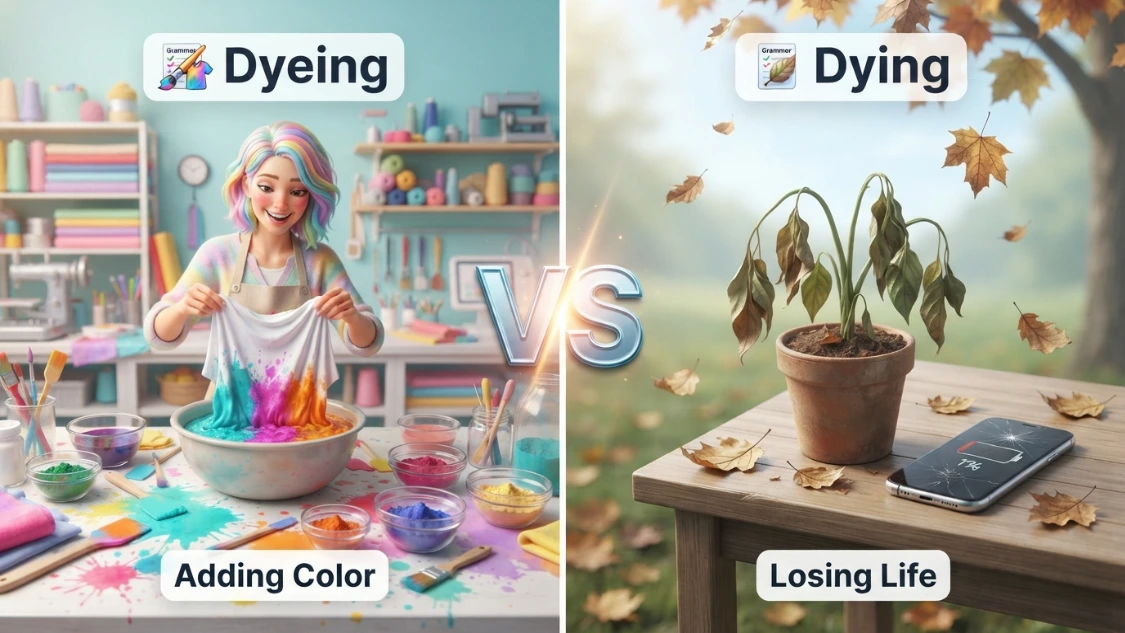
Dyeing means coloring something with dye, while dying means approaching death or coming to an end.
Dyeing or Dying: Quick Answer
Dyeing means adding color to something, such as fabric, hair, or clothing. Dying means approaching death or coming to an end. Although these words look similar, they have completely different meanings and should never be used interchangeably.
Quick Examples
- ✅ She is dyeing her hair blonde.
- ✅ The flowers are dying because they need water.
- ✅ The artist enjoys dyeing fabric with natural colors.
Have you ever paused while writing because you weren’t sure whether to use dyeing or dying? You’re not alone. These two words are among the most commonly confused in English because they differ by only one letter. However, that small difference completely changes their meaning.
Dyeing is related to adding color to materials such as hair, fabric, or clothing, while dying is the present participle of the verb die, meaning to stop living or gradually come to an end. Using the wrong word can completely change the meaning of a sentence and sometimes create awkward or humorous misunderstandings.
In this guide, you’ll learn the difference between dyeing and dying, when to use each word, practical examples, common mistakes to avoid, and an easy memory trick that will help you remember the correct usage every time.
What Do Dyeing and Dying Mean?
Although dyeing and dying are pronounced similarly, they have different definitions and uses.
What Does “Dyeing” Mean?
Dyeing is the present participle of the verb dye. It means adding color to hair, fabric, clothing, paper, or other materials using a dye.
Examples
- She is dyeing her hair brown.
- They spent the afternoon dyeing Easter eggs.
- The factory specializes in dyeing cotton fabrics.
In each example, the action involves changing the color of something.
What Does “Dying” Mean?
Dying is the present participle of the verb die. It means approaching death, stopping living, or gradually coming to an end.
Examples
- The old tree is dying because of disease.
- Many plants are dying during the drought.
- The battery is dying, so I need to charge my phone.
Here, the word describes something ending, weakening, or losing life.
What’s the Difference Between Dyeing and Dying?
The easiest way to remember the difference is this:
- Dyeing = Adding color.
- Dying = Losing life or coming to an end.
| Feature | Dyeing | Dying |
|---|---|---|
| Meaning | Coloring something | Approaching death or ending |
| Verb | Dye | Die |
| Common Use | Hair, fabric, clothes, eggs | People, animals, plants, batteries |
| Related To | Color | Life or ending |
| Example | Dyeing fabric | Dying flowers |
Compare These Sentences
Dyeing
She spent the afternoon dyeing her favorite T-shirt.
The action changes the shirt’s color.
Dying
The flowers are dying because they haven’t been watered.
The flowers are losing life.
When to Use “Dyeing”
Use dyeing whenever you are talking about adding or changing color.
1. Coloring Hair
Examples
- She is dyeing her hair black.
- He enjoys dyeing his beard.
- My sister is dyeing her hair for the wedding.
2. Coloring Fabric or Clothing
Examples
- Workers are dyeing the fabric blue.
- We spent the afternoon dyeing old T-shirts.
- The company uses eco-friendly methods for dyeing clothes.
3. Arts and Crafts
Examples
- The children enjoyed dyeing Easter eggs.
- She learned traditional methods of dyeing silk.
- Artists often experiment with dyeing different materials.
When to Use “Dying”
Use dying whenever you mean losing life, stopping functioning, or gradually ending.
1. People or Animals
Examples
- The patient is dying peacefully.
- The injured bird was dying when it was found.
- The old dog is dying of natural causes.
2. Plants
Examples
- The flowers are dying without enough sunlight.
- The tree is dying because of disease.
- Our garden is dying during the heatwave.
3. Objects or Things Coming to an End
Examples
- My phone battery is dying.
- The campfire is dying.
- The tradition is slowly dying out.
Grammar Rule Explained
The confusion comes from the verbs dye and die.
Base Verbs
- Dye = to add color.
- Die = to stop living.
Present Participles
- Dye → Dyeing
- Die → Dying
Notice that dyeing keeps the letter e from the base word dye to avoid confusion with dying. If it were spelled dying, both words would look identical despite having different meanings.
Examples
- She is dyeing her scarf with natural colors.
- The leaves are dying because of the cold weather.
This spelling difference makes English clearer and helps readers understand the intended meaning immediately.
Examples in Everyday Writing
Understanding dyeing and dying is much easier when you see how they are used in everyday situations.
In Emails
Dyeing
I’m dyeing my hair this weekend, so I’ll send you a photo afterward.
Dying
My laptop battery is dying, so I may lose our video call.
In School Writing
Dyeing
Ancient civilizations developed different methods of dyeing cloth with natural pigments.
Dying
Scientists are studying why coral reefs are dying in many parts of the world.
In Business Writing
Dyeing
Our factory specializes in dyeing premium-quality fabrics.
Dying
Several outdated products are dying in today’s competitive market.
In News Headlines
Dyeing
Local Artists Teach Traditional Fabric Dyeing Techniques
Dying
Thousands of Trees Are Dying Due to Prolonged Drought
In Social Media
Dyeing
Finally dyeing my hair pink today!
Dying
My phone is dying, so I’ll reply later!
Common Mistakes with Dyeing or Dying
Because these words sound alike, writers often confuse them.
| ❌ Incorrect | ✅ Correct | Why? |
|---|---|---|
| She is dying her hair blonde. | She is dyeing her hair blonde. | Hair is colored, not losing life. |
| The flowers are dyeing. | The flowers are dying. | Flowers are losing life. |
| My battery is dyeing. | My battery is dying. | A battery loses power; it isn’t colored. |
| They are dying Easter eggs. | They are dyeing Easter eggs. | Eggs are being colored. |
| The fabric is dying blue. | The fabric is dyeing blue. | Fabric receives color. |
Through or Thru: What’s the Difference✅
Memory Trick
A simple trick can help you remember the difference.
Dyeing = Dye = Color
Think of the letter “e” in dye as standing for “extra color.”
Example:
She is dyeing her dress blue.
Dying = Die = Life Ending
Think of die whenever something stops living or functioning.
Example:
The plant is dying because it needs water.
Practice Quiz
Choose the correct word.
1.
She is ________ her hair brown.
A. dyeing
B. dying
✅ Answer: A
2.
The flowers are ________ because they haven’t been watered.
A. dyeing
B. dying
✅ Answer: B
3.
They spent the afternoon ________ Easter eggs.
A. dyeing
B. dying
✅ Answer: A
4.
My phone battery is ________.
A. dyeing
B. dying
✅ Answer: B
5.
The company is famous for ________ silk fabrics.
A. dyeing
B. dying
✅ Answer: A
Quick Comparison Table
| Feature | Dyeing | Dying |
|---|---|---|
| Meaning | Adding color | Losing life or coming to an end |
| Base Verb | Dye | Die |
| Related To | Hair, fabric, clothing, eggs | People, animals, plants, batteries |
| Spelling Hint | Keeps the e from dye | Drops the e from die |
| Example | Dyeing a shirt | Dying flowers |
Style Guide Recommendations
Major English dictionaries and style guides use these words consistently:
- Use dyeing for the process of adding color to materials.
- Use dying when referring to death, the loss of life, or something gradually coming to an end.
- Double-check the spelling because confusing these words can completely change your sentence’s meaning.
Google Trends & Modern Usage
Both dyeing and dying are common in modern English, but they appear in different contexts.
- Dyeing is frequently used in beauty, fashion, textile manufacturing, arts and crafts, and hair care.
- Dying commonly appears in healthcare, environmental reports, literature, news articles, and everyday conversations about people, animals, plants, batteries, and traditions.
- Because they sound alike, they are among the most searched and commonly confused word pairs in English.
Did You Know?
The unusual spelling dyeing keeps the “e” from dye on purpose. If it were spelled dying, it would be identical to the present participle of die, making it impossible to distinguish between coloring something and losing life.
Grammar Relay Corner
Related Grammar Topics
- Affect vs. Effect
- Compliment vs. Complement
- Stationary vs. Stationery
- Breath vs. Breathe
- Passed vs. Past
Common Collocations
- dyeing hair
- dyeing fabric
- natural dyeing
- dying plant
- dying battery
- dying tradition
- dying language
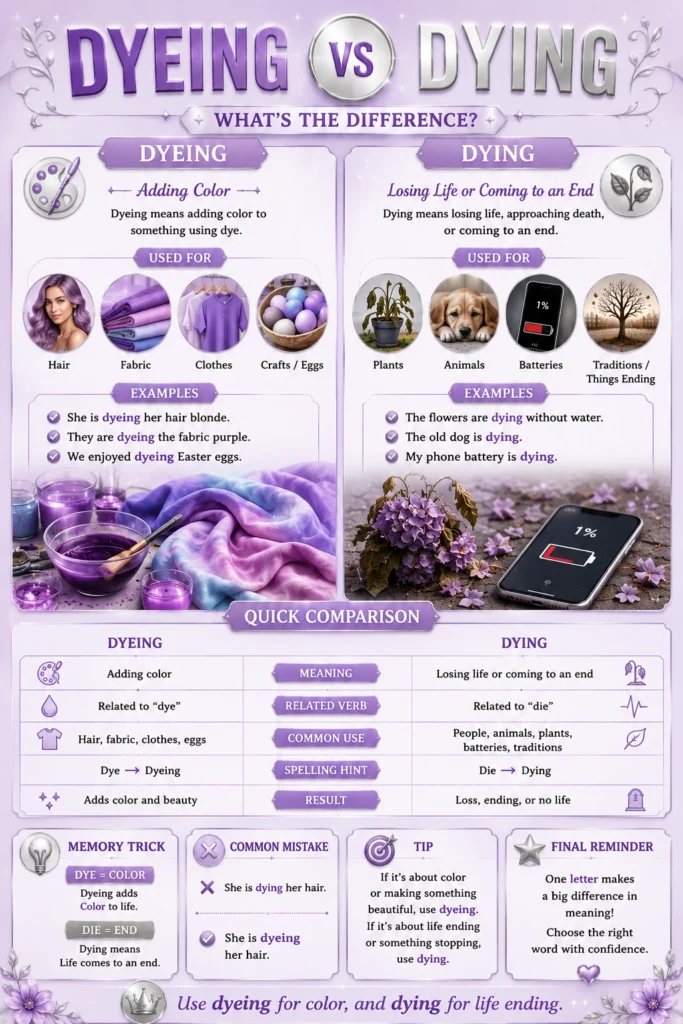
Visual Summary: Dyeing vs. Dying
Need a quick recap? The infographic below highlights the key differences between dyeing and dying in a simple visual format. It explains when to use each word, provides easy examples, highlights common mistakes, and includes a memory trick to help you choose the correct word with confidence.
Key Takeaways
- Dyeing means adding color to something.
- Dying means losing life or coming to an end.
- Use dyeing for hair, clothes, fabric, and crafts.
- Use dying for people, animals, plants, batteries, and traditions.
- Remember that dyeing keeps the “e” from dye to distinguish it from dying.
Frequently Asked Questions
Q: Is dyeing the correct spelling?
A: Yes. Dyeing is the correct present participle of dye, meaning to add color.
Q: What does dying mean?
A: Dying is the present participle of die, meaning to stop living or gradually come to an end.
Q: Why is dyeing spelled with an extra e?
A: The e is kept to distinguish dyeing from dying, which has a completely different meaning.
Q: Is “I’m dying my hair” correct?
A: No. The correct sentence is “I’m dyeing my hair.”
Q: Can a battery be dying?
A: Yes. We commonly say a battery is dying when it is running out of power.
Q: Are dyeing and dying pronounced the same?
A: Yes. They are pronounced the same but have different meanings and spellings.
Conclusion
Although dyeing and dying differ by only one letter, they have completely different meanings. Dyeing refers to adding color to hair, fabric, clothing, or other materials, while dying means losing life, stopping functioning, or gradually coming to an end. Choosing the correct word is important because using the wrong one can dramatically change the meaning of your sentence.
A simple way to remember the difference is this: dyeing relates to dye and color, while dying relates to die and life ending. Keeping this rule in mind will help you use both words accurately and confidently in everyday writing.
Engrained or Ingrained: Which Is Correct? (2026

I’m Leo Jackson, an English writer with a soft spot for the peculiarities of language and spelling. I believe good spelling shouldn’t feel like guesswork, so I break down each comparison into clear, practical explanations anyone can use. Outside of writing, I’m usually buried in a novel or hunting down the next tricky word pair to demystify.