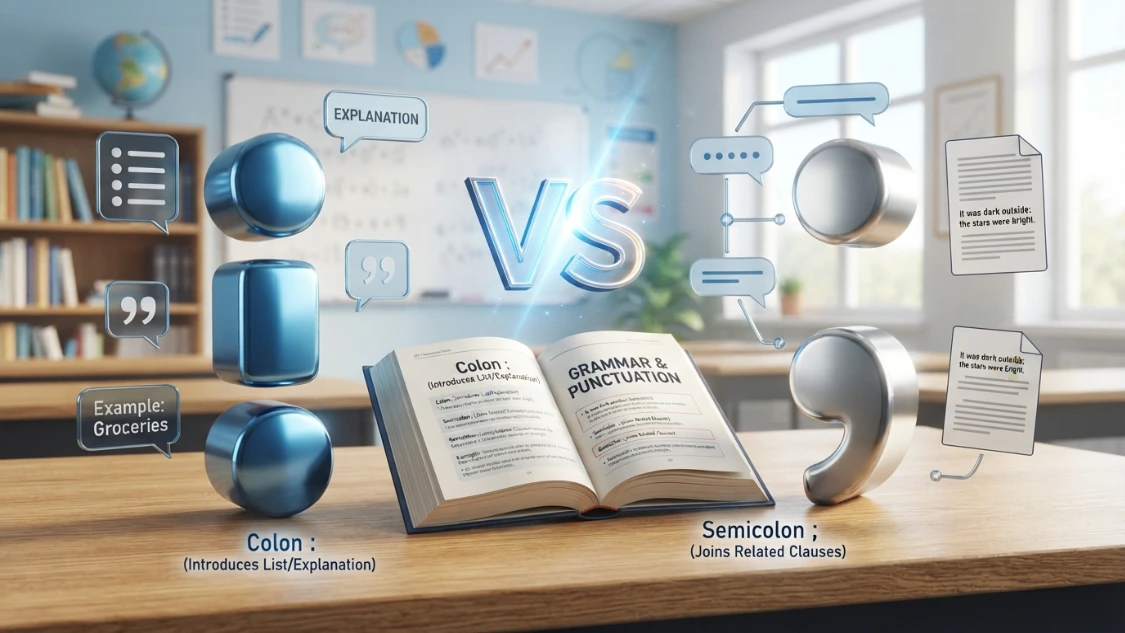
A colon (:) introduces information, while a semicolon (;) connects two closely related independent clauses or separates complex list items.
Colon or Semicolon: Quick Answer
A colon (:) introduces information, such as a list, explanation, quotation, or example. A semicolon (;) joins two closely related independent clauses or separates complex list items. Using the correct punctuation makes your writing clearer and more professional.
Quick Examples
- ✅ Bring these items: a notebook, a pen, and a calculator.
- ✅ I finished my homework; now I can watch a movie.
- ✅ She had one goal: to become a doctor.
Have you ever paused while writing and wondered whether to use a colon or semicolon? You’re not alone. These two punctuation marks often confuse students, professionals, and even experienced writers because they look similar but serve very different purposes.
Knowing when to use a colon or a semicolon can make your writing easier to read and more polished. A colon introduces information that explains or expands on what comes before it, while a semicolon connects two closely related complete sentences without using a conjunction like and or but.
Whether you’re writing an email, an academic essay, a business report, or a social media post, understanding the difference between these punctuation marks helps you communicate your ideas clearly. In this guide, you’ll learn simple rules, practical examples, common mistakes, and an easy memory trick so you can confidently choose the correct punctuation every time.
What Do Colon and Semicolon Mean?
Although they look alike, the colon (:) and semicolon (;) perform different jobs in English writing.
What Is a Colon?
A colon tells the reader that more information is coming. The information after the colon explains, introduces, or expands on the first part of the sentence.
Examples
- She packed everything she needed: clothes, shoes, and toiletries.
- There was only one answer: practice.
- Remember this rule: always proofread your work.
What Is a Semicolon?
A semicolon connects two complete sentences that are closely related in meaning. It creates a stronger connection than a period but a longer pause than a comma.
Examples
- The rain finally stopped; we went outside.
- I enjoy reading mystery novels; my sister prefers science fiction.
- The meeting ended early; everyone went home happy.
What’s the Difference Between a Colon and a Semicolon?
The easiest way to remember the difference is this:
- A colon introduces something.
- A semicolon connects related complete ideas.
| Feature | Colon (:) | Semicolon (;) |
|---|---|---|
| Main Purpose | Introduces information | Connects related independent clauses |
| Comes Before | A list, explanation, quotation, or example | Another complete sentence |
| Can Join Two Complete Sentences? | Usually no | Yes |
| Reader Expectation | “More information is coming.” | “These two ideas are connected.” |
| Common Use | Lists and explanations | Linking related thoughts |
Compare These Sentences
Colon
She had one dream: to travel around the world.
The second part explains the dream.
Semicolon
She saved money for years; she finally traveled around the world.
Both parts are complete sentences connected by a semicolon.
When to Use a Colon
Use a colon when what follows explains, introduces, or completes the first part of the sentence.
1. Before a List
A colon introduces a list after a complete sentence.
Examples
- Please buy the following items: milk, eggs, bread, and butter.
- The recipe requires three ingredients: flour, sugar, and eggs.
- We visited four cities: Paris, Rome, Madrid, and Lisbon.
2. Before an Explanation
Use a colon when the second part explains the first.
Examples
- There was one problem: nobody remembered the password.
- She knew the truth: honesty is always the best choice.
- He achieved his goal: graduating with honors.
3. Before a Quotation
A colon can introduce a quotation after a complete sentence.
Examples
The teacher said: “Practice makes perfect.”
My grandfather always reminded us: “Kindness costs nothing.”
4. Before an Example
Use a colon before examples that clarify your point.
Examples
Several countries celebrate Thanksgiving differently: Canada observes it in October, while the United States celebrates it in November.
Healthy habits include the following: exercising regularly, eating balanced meals, and sleeping well.
When to Use a Semicolon
A semicolon has several important uses.
1. Between Two Related Independent Clauses
Each side of the semicolon must be able to stand alone as a complete sentence.
Examples
- The library was closed; we studied at home.
- She loves coffee; her brother prefers tea.
- The project was difficult; everyone learned something valuable.
2. Before Transitional Words
Use a semicolon before words like however, therefore, moreover, otherwise, and nevertheless when they connect two complete sentences.
Examples
- I wanted to go for a walk; however, it started raining.
- The exam was difficult; nevertheless, most students passed.
- She studied every evening; therefore, she earned excellent grades.
3. In Complex Lists
When list items already contain commas, semicolons make the list easier to read.
Example
The conference welcomed guests from Lahore, Pakistan; London, England; Toronto, Canada; and Sydney, Australia.
👉🏻Common Word Confusions
Writers who struggle with punctuation often confuse Its vs. it’s as well. Learning the difference between the possessive form and the contraction will help you write cleaner, more accurate sentences.
Examples in Everyday Writing
Understanding colon or semicolon becomes much easier when you see how they appear in real writing.
In Emails
Colon
Please bring the following documents: your passport, ID card, and application form.
Semicolon
I received your email; I’ll reply by this afternoon.
In Business Writing
Colon
Our priorities are clear: improve quality, reduce costs, and increase customer satisfaction.
Semicolon
Sales increased during the first quarter; profits also improved significantly.
In School Writing
Colon
The experiment produced one clear result: plants need sunlight to grow.
Semicolon
The research was extensive; the conclusions were well supported.
In News Headlines
Colon
Weather Alert: Heavy Rain Expected Tomorrow
Budget Announcement: Government Increases Education Funding
In Social Media
Colon
Today’s goals: stay positive, work hard, and drink more water.
Semicolon
Monday was exhausting; Tuesday feels much better already!
Common Mistakes with Colon or Semicolon
Many writers confuse these punctuation marks. Here are the most common mistakes and how to fix them.
| ❌ Incorrect | ✅ Correct | Why? |
|---|---|---|
| I bought: apples, bananas, and oranges. | I bought apples, bananas, and oranges. | Don’t use a colon after an incomplete sentence. |
| She was tired: she went home. | She was tired; she went home. | Use a semicolon to connect two complete sentences. |
| My favorite colors are blue; green; and red. | My favorite colors are blue, green, and red. | A simple list needs commas, not semicolons. |
| We need three things; patience, effort, and teamwork. | We need three things: patience, effort, and teamwork. | A colon introduces a list. |
| The weather improved however we stayed home. | The weather improved; however, we stayed home. | Use a semicolon before “however” when joining two complete sentences. |
👉🏻Mastering colons and semicolons is only one step toward clearer writing. Another rule that confuses writers is Who vs. whom, which depends on whether the word acts as the subject or the object of a sentence. A simple memory trick is to use who if he\she fits and whom if him\her fits.
Memory Trick
Here’s an easy way to remember the difference.
Think of a Colon (:) as saying:
“Here it comes!”
It introduces something new.
Example:
She had one wish: to travel the world.
Think of a Semicolon (;) as saying:
“These ideas belong together.”
It connects two related complete thoughts.
Example:
I enjoy writing; my sister enjoys reading.
Practice Quiz
Choose the correct punctuation.
1.
Please bring these items ___ a notebook, a pen, and a ruler.
A. Colon
B. Semicolon
✅ Answer: A
2.
The movie ended late ___ everyone went straight home.
A. Colon
B. Semicolon
✅ Answer: B
3.
There was one problem ___ nobody had the key.
A. Colon
B. Semicolon
✅ Answer: A
4.
The weather was cold ___ we decided to stay indoors.
A. Colon
B. Semicolon
✅ Answer: B
5.
Healthy habits include the following ___ regular exercise, healthy eating, and enough sleep.
A. Colon
B. Semicolon
✅ Answer: A
Quick Comparison Table
| Feature | Colon (:) | Semicolon (;) |
|---|---|---|
| Introduces a list | ✅ | ❌ |
| Introduces an explanation | ✅ | ❌ |
| Introduces a quotation | ✅ | ❌ |
| Joins two complete sentences | ❌ | ✅ |
| Used before “however” between complete sentences | ❌ | ✅ |
| Separates complex list items | ❌ | ✅ |
Style Guide Recommendations
Major English style guides agree on these basic rules:
- Use a colon after a complete sentence to introduce a list, explanation, quotation, or example.
- Use a semicolon to connect closely related independent clauses without a coordinating conjunction.
- Use semicolons in complex lists when list items already contain commas.
- Avoid replacing commas or periods with semicolons unless the grammar supports it.
Usage in Modern writing
Both punctuation marks are common in modern English, but they appear in different situations.
- Colons are frequently used in academic writing, business documents, recipes, manuals, headlines, and presentations because they introduce information clearly.
- Semicolons are more common in formal writing, essays, reports, and professional documents where closely related ideas need to be connected.
- In casual texting and social media, many writers use shorter sentences instead of semicolons, while colons remain popular for introducing lists and announcements.
Did You Know?
The semicolon was introduced by the Italian printer Aldus Manutius in the late 15th century. He created it to connect related ideas more smoothly than a period while providing a stronger pause than a comma. Today, it remains one of the most misunderstood punctuation marks in English.
Visual Summary: Colon vs. Semicolon
Need a quick recap? The infographic below highlights the key differences between a colon (:) and a semicolon (;) in a simple, visual format. It shows when to use each punctuation mark, common mistakes to avoid, an easy memory trick, and everyday examples to help you remember the correct usage. If you’re short on time or want a fast review before writing, this visual summary provides everything you need at a glance.

Grammar Relay Corner
Related Grammar Topic
Comma vs. Semicolon – Learn when a comma is enough and when a semicolon is the better choice.
Similar Confusing Punctuation
- Colon vs. Dash
- Comma vs. Colon
- Parentheses vs. Em Dash
Common Collocations
- use a colon
- use a semicolon
- punctuation mark
- independent clause
- complete sentence
- writing style
- grammar rule
Key Takeaways
- A colon (:) introduces information.
- A semicolon (;) connects closely related complete sentences.
- Use a colon before lists, explanations, quotations, and examples.
- Use a semicolon between related independent clauses.
- Use semicolons to separate items in complex lists.
- Don’t use a colon after an incomplete sentence.
- Choose the punctuation mark based on the relationship between ideas.
- 👉🏻Clear writing isn’t just about punctuation. Writers also need to choose the right words, and Their vs. There remains one of the most common sources of confusion in everyday English. Learning the difference between possession and location will help you write with greater accuracy and confidence.
Frequently Asked Questions
Q: Is a colon the same as a semicolon?
A: No. A colon introduces information, while a semicolon connects two related complete sentences.
Q: When should I use a colon?
A: Use a colon before a list, explanation, quotation, or example after a complete sentence.
Q: When should I use a semicolon?
A: Use a semicolon to join two closely related independent clauses or to separate complex list items.
Q: Can a semicolon replace a period?
A: Yes, when two complete sentences are closely related in meaning.
Q: Can I use a colon before every list?
A: No. The words before the colon must form a complete sentence.
Q: Which punctuation mark is more common?
A: Both are common, but colons appear more often in everyday writing, while semicolons are more frequent in formal and academic writing.
Conclusion
Understanding the difference between a colon and a semicolon can greatly improve your writing. Although these punctuation marks look similar, they serve different purposes. A colon introduces information such as a list, explanation, quotation, or example, while a semicolon connects two closely related complete sentences or separates items in a complex list.
A simple way to remember the difference is this: a colon introduces, and a semicolon connects. Whenever you’re unsure, ask yourself whether you’re presenting new information or linking two complete ideas. The answer will help you choose the correct punctuation.
With regular practice, using colons and semicolons will become second nature, making your emails, essays, reports, and everyday writing clearer, more professional, and easier to understand.

“I am Paul Emerson, a language writer dedicated to untangling the English language’s trickiest spelling dilemmas. With a sharp eye for detail, I break down confusing word pairs into clear, simple comparisons anyone can grasp.”